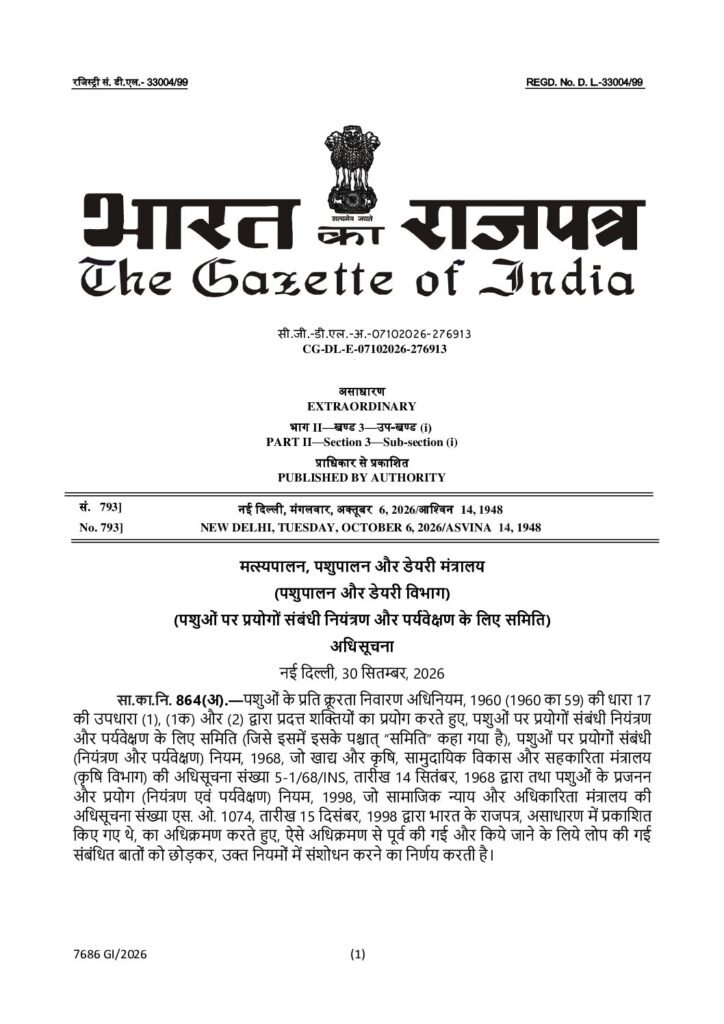
Draft. Objections and suggestions can be sent to CCSEA until : cpcsea-mef@gov.in, or Member Secretary (CCSEA), Office of CCSEA, Near State Bank of India, Delhi Milk Scheme Complex, Shadipur, Delhi – 110008.
English text of the notification as published in the Gazette of India, Extraordinary, No. 793, . The forms in Schedules I to VII are in the PDF.
New Delhi, the 30th September, 2026 G.S.R. 864(E).—In exercise of the powers conferred by sub-section (1), 1(A) and (2) of Section 17 of Prevention of Cruelty to Animals Act, 1960 (59 of 1960), the Committee for Control and Supervision of Experiments on Animals (hereinafter referred to as ‘Committee’), in supersession of the Experiments on Animals (Control and Supervision) Rules, 1968 vide Ministry of Food and Agriculture, Community Development and Co-operation (Department of Agriculture) notification no. 5-1/68/INS dated 14th September, 1968 and the Breeding of and Experiments on Animals (Control & Supervision) Rules, 1998 vide Ministry of Social Justice and Empowerment notification No. S.O. 1074 dated 15th December, 1998 published in Extraordinary Gazette of India, hereby decided to amend the aforementioned rules, except as respect things done or omitted to be done before such supersession; Objections and suggestions, if any, may be communicated to the Member Secretary (CCSEA), Office of CCSEA, Near State Bank of India, Delhi Milk Scheme Complex, Shadipur, Delhi – 110008 or by email cpcsea-mef@gov.in within a period of thirty days. DRAFT RULES
1. Short title and commencement
(1) These rules may be called the Prevention of Cruelty to Animals (Control and Supervision of Experiment, Breeding and Trading of Laboratory Animals) Rules, 2026.
(2) They shall come into force on the date of their publication in the Official Gazette.
(3) These Rules will establish measures for the protection of animals used for scientific or educational purposes.
(4) To that end, these rules lays down guidelines for the following:
(a) the replacement and reduction of the use of animals in experiments and the refinement of the breeding, accommodation, care and use of animals in experiments;
(b) the origin, breeding, marking, care and accommodation and euthanasia of animals;
(c) the operati on of breeders, traders and users;
(d) the evaluation and authorisation of projects involving the use of animals in experiments (5) These Rules shall apply where animals are used or intended to be used in experiments or bred specifically so that their organs or tissues may be used for scientific purposes.
(6) These Rules shall apply until the animals have been euthanized, rehabilitated to a suitable habitat or husbandry system upon completion of experimentation.
(7) The elimination of pain, suffering, distress or lasting harm by the successful use of anaesthesia, analgesia or other methods shall not exclude the use of an animal in experiments from the scope of these Rules.
(8) These Rules shall apply to live non-human vertebrate animals, including independent feeding larval forms of fishes, embryonated eggs and foetal forms of mammals as from the last third stage of their normal development;
(9) These Rules shall apply to animals used in experiments, which are at an earlier stage of development than that referred to sub-rule 8, if the animal is to be allowed to live beyond that stage of development and, as a result of the experiments performed, is likely to experience pain, suffering, distress or lasting harm after it has reached that stage of development.
(10) These Rules shall not apply to the following:
(a) non-experimental agricultural practices;
(b) non-experimental clinical veterinary practices;
(c) veterinary clinical field trial required for the marketing authorization of a legally approved veterinary medicinal product except test batch and quality control trial for batch manufacturing;
(d) practices undertaken for the purposes of recognised animal husbandry;
(e) practices undertaken for the primary purpose of identification of an animal;
(f) practices not likely to cause pain, suffering, distress or lasting harm equivalent to, or higher than, that caused by the introduction of a needle in accordance with good veterinary practice.
2. Definitions
In these rules, unless the context otherwise requires,-
(a) “Act” means the Prevention of Cruelty to Animals Act, 1960 (59 of 1960);
(b) “Board” means the Animal Welfare Board of India established under section 4 and as reconstituted from time to time under section 5A of the Act;
(c) “Breeder” means any natural or legal person registered with Committee breeding animals with a view to their use for in-house experiments or for the use of their tissue or organs for scientific purposes or supplying to other registered establishments whether for profit or not;
(d) “CCSEA” means the Committee for Control and Supervision of Experiments on Animals established under sub-section (1) of section 15 of the Act, (hereinafter referred to as “Committee);
(e) “Chairman” means the Chairman nominated under sub-section (2) of section 15 of the Act;
(f) “Collaborative Research” means any experiment undertaken between two or more research institutions solely for the purpose of advancement of scientific research for human or animal welfare;
(g) “Contract Research” means any research undertaken by both domestic as well as foreign individual, company, firm, corporation or institution on behalf of an individual, company, firm, corporation or institution for consideration for profit or not;
(h) “Experimentation” means any programme or project involving use of animal for acquisition of knowledge of a biological, physiological, ethological, physical or chemical nature; and includes the use of animal in the production of reagents and products such as antigens and antibodies, routine diagnostics, testing activity and establishment of transgenic stocks, for the purpose of saving or prolonging life or alleviating suffering or significant gains in wellbeing for people of the country or for combating any disease whether of human beings or animals;
(i) “Establishment” means any installation, building, group of buildings or other premises, including a place that is not wholly enclosed or covered and mobile facilities, where laboratory animals are bred, housed, traded or used for experiments.
(j) “Guidelines” means any documents or direction issued by the CCSEA from time to time to carry out the purpose of implementation of the Act or Rules made thereunder;
(k) “Humane Endpoint” means a predetermined criterion that identifies when an animal’s pain, suffering, distress, or impairment of well-being has reached a level at which action must be taken to prevent further suffering of animals and terminate the experiment.
(l) “Institutional Animals Ethics Committee” means a body comprising a group of persons recognised and registered by the CCSEA in an establishment which is constituted and operated in accordance with experiments specified for the purpose by the Committee, (hereinafter referred to as “IAEC”);
(m) “Invasive experiment” means any procedure that involves animal restraint, blood collection, injection or any intervention that alters normal anatomy, or causes physiological interference by breaching the body’s natural barriers. Such procedures include, but are not limited to: Surgical interventions, such as organ transplantation, implantation of telemetry devices or catheters; Sample collection including blood or tissue sampling that requires significant incisions or deep punctures beyond routine veterinary practice; and Administration procedures such as repeated oral gavage or deep-tissue injections.
(n) “Laboratory animals” means all vertebrate animals used or intended to be used in experiments regulated under these Rules;
(o) “Member” means a Member of the Committee for Control and Supervision of Experiments on Animals;
(p) “Member-Secretary” means the Member-Secretary to the Committee for Control and Supervision of Experiments on Animals;
(q) “Nominee” means the person selected by the Committee as its representative to carry out the work of CCSEA;
(r) “Non-invasive experiment” mean experiments that do not involve any breach of the skin or surgical intervention and shall be employed wherever the scientific objective can be achieved without invasive procedures. Such experiments may include, inter alia, the use of non-invasive imaging techniques for monitoring physiological or pathological changes, the collection of biological samples such as faeces, urine or naturally shed hair for scientific analysis, and behavioural observation or monitoring of animals in non-restrictive environments without causing pain, distress or injury.
(s) “Project” means a programme of work having a defined scientific objective and involving one or more experiments;
(t) “Specified format” means the forms specified for the purpose by the Committee from time to time;
(u) “Trader” means any natural or legal person registered with the Committee, supplying animals to the establishments registered with the Committee, with a view to their use in experiments or for the use of their tissue or organs for scientific purposes, whether for profit or not;
(v) “User” means an establishment registered with Committee using animals in experiments, whether for profit or not;
(w) “Veterinarian” means a person registered with Veterinary Council of India or State Veterinary Council, as the case may be, holding degree from a recognized Veterinary Institution.
3. Replacement, Reduction and Refinement (3Rs)
For the purpose of implementation of principle of replacement, reduction and refinement (3Rs), the registered establishments carrying out the experiment shall ensure.-
(1) that, wherever possible, a scientifically satisfactory method or testing strategy, not entailing the use of live animals, shall be used instead of an experiment;
(2) that the number of animals used in projects is reduced to a minimum necessary to obtain scientifically valid and statistically reliable results without compromising the objectives of the project;
(3) that refinement of breeding, accommodation and care, and of methods used in experiments, eliminating or reducing to the minimum any possible pain, suffering, distress or lasting harm to the animals, adequate environmental enrichment, adoption of best veterinary practices and the use of validated humane endpoints.
4. Purposes of Experiments
Experiments may be carried out for the following purposes only:
(1) basic research aimed at the advancement of knowledge, including fundamental research in biological, biomedical, behavioural or veterinary sciences.
(2) translational or applied research with one or more of the following aims:
(a) the avoidance, prevention, diagnosis or treatment of disease, ill-health or other pathological conditions or their effects on human beings, animals or plants;
(b) the assessment, detection, regulation or modification of physiological conditions in human beings, animals or plants; or
(c) the welfare of animals and the improvement of the production conditions for animals reared for agricultural purposes;
(3) for any of the aims in sub-rule (2) in the development, manufacture or testing of the quality, effectiveness and safety of drugs, food and feed stuffs and other substances or products;
(4) protection of the natural environment in the interests of the health or welfare of human beings or animals;
(5) research aimed at preservation of the species;
(6) higher education, or professional training for the acquisition, maintenance or improvement of vocational skills;
(7) forensic investigations in accordance with the legal requirement.
(8) Process of bleeding/blood products
5. Category of animals on which the experiment shall be prohibited
(1) Specimens of those animals protected under Wildlife (Protection) Amendment Act, 2022, shall not be used in experiments, with the exceptions of those experiments meeting the following conditions:
(a) the experiment has one of the purposes referred to in clause (a) of sub-rule (2), sub-rule (3) or sub-rule ( 5) of Rule 4 of these Rules; and
(b) there is scientific justification to the effect that the purpose of the experiment cannot be achieved using species other than the endangered species;
(c) sub-rule (1) shall not apply to any species of non-human primates;
(d) permission of competent authorities as per applicable law has been granted.
(2) Animals taken from the wild-
(a) Animals taken from the wild shall not be used in experiments unless the Competent authority of the relevant department grants exemptions based on scientific justification to the effect that the purpose of the experiments cannot be achieved by the use of an animal which has been bred for use in experiments;
(b) The capture of animals in the wild shall be carried out only by authorised competent person using methods which do not cause the animals avoidable pain, suffering, distress or lasting harm;
(c) Any animal found during or after capture, injured or in poor health shall be examined by a veterinarian or any other authorized person under the supervision of a veterinarian, and action shall be taken to minimise the suffering of the animal. Competent authorities may grant exemptions from the requirement of taking action to minimise the suffering of the animal if there is scientific justification;
(d) The Committee shall review the use of sourcing non- human primates from self- sustaining colonies as defined in the guidelines of CCSEA.
(3) Stray and feral animals of domestic species.- Stray and feral animals of domestic species shall not be used in experiments provided; the competent authorities may grant exemptions subject to the following conditions.-
(a) there is an essential need for studies concerning the health and welfare of the animals or serious threats to the environment or to human or animal health; and
(b) there is scientific justification to the effect that the purpose of the experiment can be achieved only by using stray or a feral animal.
6. Experiment on non-human primates
Subject to Rule 5, specimens of non-human primates shall not be used in experiments, except for those experiments meeting the following conditions.-
(1) the experiment has one of the purposes referred to in-
(a) clause (a) of sub-rule (2) or sub-rule (3) of Rule 4 of these Rules is undertaken with a view to the avoidance, prevention, diagnosis or treatment of debilitating or potentially life- threatening clinical conditions in human beings; or
(b) sub-rule (1) or (5) of Rule 4; and
(c) there is scientific justification to the effect that the purpose of the experiment cannot be achieved by the use of species other than non- human primates. Note: A debilitating clinical condition for the purposes of these Rules means a reduction in a person’s normal physical or psychological ability to function.
(2) Specimens of non-human primates listed in the Wildlife (Protection) Amendment Act, 2022, shall not be used in experiments.
7. Classification of severity of experiments
(1) The establishment shall follow the severity of experiment, classified as ‘non-recovery’, ‘mild’, ‘moderate’, or ‘severe’ on a case-by-case basis as set out in Annexure -I (2) The establishments shall ensure that an experiment is not performed if it involves severe pain, suffering or distress that is likely to be long period and cannot be ameliorated.
8. Requirements for breeders, traders and users
(1) No establishment shall carry out the business or house animals for breeding or trading of animals for the purpose of experiments unless it is registered with the CCSEA;
(2) Every breeder, trader or establishment shall apply for registration through existing online portal developed by CCSEA for carrying out the business of:
(i) breeding animals for the purpose of experiments (ii) trading of animals for the purpose of experiments,
(iii) breeding and trading animals for the purpose of experiment (3) The Traders shall ensure that animals bred, procured and housed by the establishment are traded only to the CCSEA registered establishments on approval of the IAEC of the receiving establishment or Committee, as the case may be.
(4) The breeders and traders shall submit quarterly report to IAEC and annual report for each financial year in the prescribed form at schedule VII on or before 31st March of each year to the Committee.
9. Registration of establishments conducting experiments on animals or housing, breeding and trading of animals for experimental purposes
(1) No establishment shall perform any experiment on animals or house, breed and/or trade any animal for experiments unless it is registered with the CCSEA as per the provisions under these rule(s).
(2) Every establishment performing experiments on animal(s) or housing, breeding and trading of animals for experimental purposes shall apply for registration, in prescribed format at schedule I through online portal of CCSEA to the Member Secretary with specified fees.
10. Processing of applications
(1) All the applications submitted as per Rule 9 in the office of CCSEA shall be processed as under:
(a) The Member-Secretary shall verify the fact by himself or depute nominee of CCSEA or representative of CCSEA for verification of facts mentioned in the application for registration;
(b) After receiving satisfactory report and information in Schedule II, the Member Secretary shall register such establishment;
(c) An establishment shall be duty-bound to comply with the conditions of registration, or any conditions prescribed by the Committee;
(d) The Committee shall take a decision on the registration within specified period as mentioned in the Administrative (Committee for Control and Supervision of Experiments on Animals) Rules, 2023;
(e) The Committee shall communicate the modification of facilities, if needed, before registration and taking the final decision on registration;
(f) Each establishment registered under Committee shall bear a unique registration code and number for each purpose;
(g) The registration certificate issued to the establishment maintaining Animal House Facilities including the IAEC shall remain valid for three years unless its terminated or withdrawn by the establishment or Committee as the case may be.
11. Permission of the Committee required for conducting experiments
(1) Every establishment registered with CCSEA shall obtain permission either from the Committee or the Institutional Animals Ethics Committee before conducting experiment, as the case may be;
(2) Every establishment, conducting severe and non-recovery experiments as defined under Rule 7 on animals above the category of rodent and lagomorph, shall apply to CCSEA by providing details in Schedule III through online portal after recommendation of IAEC. Decision on such applications shall be taken by the Committee within thirty working days.
(3) Every establishment conducting experiments which have been defined as mild and moderate including such experiments on all animals, shall submit their application as per Schedule III to the Member Secretary of IAEC for decision on the experiment. Such experiment shall not be referred to the Committee;
(4) In case of approvals on mild and moderate experiments on animals above lagomorphs, the IAEC shall ensure timely and scheduled reporting to the Committee, at a minimum of three stages namely; study initiation, interim progress, and study completion—covering progress, deviations (if any), and compliance with the principles of the 3Rs (Replacement, Reduction, and Refinement), as specified;
(5) Reports submitted by the IAEC shall be placed before the committee at the next available meeting of the Committee;
(6) The Member Secretary of the Committee or the IAEC, shall cause the application for permission to be brought before the Committee or IAEC as the case may be, and the Committee or IAEC after scrutiny of the application, if satisfied, may grant permission to the establishment stating the name of the species and the number of animals that can be acquired or used for carrying out the specific experiment;
(7) The Committee or IAEC while granting permission for conducting experiments on animals, may prescribe conditions as may deem fit to ensure that animals are not subjected to unnecessary pain or suffering before, during or after the performance of experiments on them;
(8) The Committee may seek such information, as it may require but limited to the welfare of the animals, on completion of experiments for which permission was granted.
(9) The principal investigator carrying out experiments shall maintain the information as per Schedule IV which shall be submitted to Member Secretary of the IAEC in the first meeting fixed immediately after completion of experiment;
(10) The animal(s) to be used for experimentation shall mandatorily be certified by the Veterinarian of the IAEC to the effect that the experiments are mild, severe, moderate or non- invasive in nature and the animal is fit for the desired experiment;
(11) The IAEC may grant approval for class of experiment of repetitive or curriculum-based teaching for a period not exceeding five years subject to such conditions and periodic reviews as may be specified by the committee; Provided that fresh approval shall be required where there is any material change in species, number of animals, severity of experiment or experimental procedure.
12. Competency of personnel
(1) Person in-charge or Head of the establishments shall ensure that each breeder, trader and user has sufficient staff on site.
(2) The staff should be adequately educated and trained before they perform any of the following functions (a) carrying out experiments on animals;
(b) designing experiments and projects;
(c) taking care of animals; or
(d) euthanasia of animals. Note: The establishment shall maintain proper documents in support of education, experience, registration of veterinarian and training.
(3) Persons carrying out the functions referred to in clause (b) shall have received instruction in a scientific discipline relevant to the work being undertaken and shall have species-specific knowledge.
(4) Staff carrying out functions referred to in clause (a), (c) or (d) shall be supervised in the performance of their tasks until they have demonstrated the requisite competence.
(5) Establishment shall ensure, through authorisation or by other means, that the requirements laid down in this paragraph are fulfilled.
(6) Establishment shall publish minimum requirements with regard to education and training and the requirements for obtaining, maintaining and demonstrating requisite competence for the functions set out in paragraph 2.
13. Specific requirements for personnel
(1) the Person in-charge or Head of the establishment shall ensure that each breeder, trader and user has one or several persons on site who shall:
(a) be responsible for overseeing the welfare and care of the animals in the establishment;
(b) ensure that the staff dealing with animals have access to information specific to the species housed in the establishment;
(c) be responsible for ensuring that the staff are adequately educated, competent and continuously trained and that they are supervised until they have demonstrated the requisite competence.
(2) Person in charge or Head of establishments shall ensure that personnel shall:
(a) ensure that any unnecessary pain, suffering, distress or lasting harm that is being inflicted on an animal in the course of an experiment is stopped; and
(b) ensure that the projects are carried out in accordance with the project authorisation or, in accordance with the application sent to the IAEC or CCSEA or any decision taken by the IAEC or CCSEA, and ensure that in the event of non-compliance, the appropriate measures to rectify it are taken and recorded.
14. Designated veterinarian
(1) The person in charge of establishments shall ensure that each breeder and user has appointed a veterinarian to advise and monitor the well-being and treatment of animals.
(2) All experiments shall be performed under the supervision of a veterinarian.
15. Procedures for experiments
(1) The CCSEA shall issue detailed order or guidelines for experiments, or breeding or trading of an animal from time to time to minimize their pain and sufferings before, during and after the experimentation including rehabilitation and reuse;
(2) The CCSEA shall also prescribe the specific standards for welfare of animals to be followed by the establishment for housing animals during and after the experiment on animals which shall be binding on the establishments;
(3) The establishment shall not perform any experiment or use any chemical or agents which are banned by any authority and not required for testing.
(4) As far as possible, death as the endpoint of an experiment shall be avoided and replaced by early and humane endpoints. If death as the endpoint is unavoidable, the experiment shall be designed so as to:
(a) minimize the number of deaths of animals as much as possible; and
(b) minimize as much as possible, the duration and intensity of suffering to the animal to ensure a painless death;
(c) every establishment must maintain a dedicated euthanasia registry detailing the date, species, exact method/chemical agent utilized, dosage, reason for termination, and the co- signatures of both the executing investigator and the Designated Veterinarian.
16. Composition of Institutional Animals Ethics Committee (IAEC)
(1) Every establishment shall mandatorily constitute nine members for control and supervision of experiment, breeding, housing and trading which will be valid for three years.
(2) The constitution of IAEC shall include a biologist, two scientists from different biological disciplines, a veterinarian involved in the care of animals, and the scientist in charge of animal facility from the respective establishments. The CCSEA shall nominate a main nominee, link nominee, scientist from outside the institute and socially aware nominee in the IAEC;
(3) The nominees of CCSEA shall be selected from the list of nominees selected by CCSEA after due process;
(4) The establishment shall nominate Chairperson and Member Secretary from amongst the internal members of IAEC except the nominated members by the CCSEA;
(5) In addition to the above IAEC members, a specialist, in the relevant field, shall be co- opted while reviewing special projects using hazardous agents such as radio-active substances and deadly micro-organisms. Though, the co-opted member shall not be part of the decision making of the IAEC, their advice to be taken seriously before making any decision by IAEC.
(6) IAEC shall not be required for Traders involved in supply of animals from breeders to the users without housing of animals.
17. Conduct of business of IAEC
(1) The Chairperson of IAEC shall convene minimum of two meetings of IAEC in a calendar year, requiring at least one meeting to be held in each half of a calendar year;
(2) The quorum of the IAEC meeting shall be of six members wherein mandatory presence of Main Nominee and Socially Aware Nominee is must;
(3) Link Nominee can attend any IAEC meeting in case Main Nominee conveys his/ her unavailability in writing to the Chairperson of IAEC.
(4) Any decision taken in the meetings of IAEC without quorum shall be considered invalid;
(5) The Chairperson is responsible for submission of minutes of the meeting of IAEC through the web portal within fifteen days from the date of the IAEC meeting as per Schedule V.
18. Record keeping of experiments conducted
(1) Every establishment shall maintain the records of animals utilized for Experiments in the Schedule IV, animals bred or acquired for experimentation in the Schedule VI and record of animal sold or transferred in the Schedule VII.
(2) All such records shall be made available for inspection to the Committee or any other officer authorized by the Committee from time to time.
19. Stocking of animals for experiments, breeding, housing and trading
(1) The Committee shall prescribe technical parameters for stocking of animals including technical specifications for their housing but not limited to the following broad guidelines.-
(a) Animal houses shall be located in a quiet atmosphere undisturbed by traffic, and the premises kept tidy, hygienic and the animals protected from drought and extremes of weather.
(b) Animal cages for small animals and stables for large animals shall be made in such a manner that provides comfort to animals and not overcrowded.
(c) Where standards have been laid down by the Committee, the cages, the stable, as the case may be, shall conform to those standards.
(d) Detailed specifications for housing, feeding and maintenance of various species to be used in animal experimentation as notified by the Committee, shall be adhered by the registered establishment.
(e) Each establishment shall provide species specific environmental enrichment and ethological needs.
(f) Establishment housing large animals must maintain species-specific exercise and rehabilitation area as the case may be.
(2) Registered establishments housing animals exposed to Risk Group III or IV agents must maintain certified directional airflow and negative pressure integrity, subject to mandatory digital logging and annual verification by a specialized biosecurity engineer.
20. Reporting by establishment
The breeder-trader shall submit information pertaining to trading of animals in the prescribed format as mentioned in the Schedule VII annually before 31st March of every year; or any other information sought by the Committee from time to time.
21. Transfer and acquisition of animals for experiment
(1) Any registered breeder, user or establishment under these rules shall transfer or sale or acquire any animal from the CCSEA registered breeder, establishment or trader only;
(2) In the event of non-availability of a particular kind of livestock and farm animals (above level of Lagomorpha), fishes and birds, from the registered breeders or traders, they may be procured from non-registered establishments or open market with prior approval of IAEC and maintenance of documents provided such animals undergo a mandatory veterinarian-certified quarantine and stabilization period as prescribed by CCSEA guidelines prior to experimentation.
(3) Animals that are not available in the country shall be permitted for sourcing from outside the country as per the provisions of the extant Import-Export policies/guidelines.
22. Contract research on animals
Any research institutions or agency not defined under the rules may also outsource research activities involving animals to an establishment duly registered under CCSEA.
23. Renewal
(1) Every establishment registered with CCSEA is required to be renewed after every three years along with the reconstruction of IAEC.
(2) While considering the renewal, the CCSEA shall consider the minutes of IAEC meetings submitted by the establishment regularly for last three years along with the Annual Inspection Reports of the Animal House Facility by the nominee in the Schedule VIII vis-à-vis Annual statement of large animals use (as the case may be) submitted in Schedule IX for last three years.
24. Periodical inspection of the establishment
(1) It is binding on the main nominee and socially aware nominee to carry out periodical inspections not less than two times in a years, apart from the meeting, to oversee the animal house with regard to their fulfilment of the CCSEA guidelines, welfare of animals housed in the establishment;
(2) The main nominee shall submit such inspection report as per Schedule VIII format annexed to these Rules;
(3) Any violations of the CCSEA rules, guidelines and prescribed standards observed by the main nominee and socially aware nominee shall be reflected in the Minutes of the IAEC meeting and also reported to the CCSEA;
(4) CCSEA shall also depute the inspection team to verify the compliance by the establishment, with prior intimation and such report shall be submitted as per Schedule II format.
25. Power to suspend or revoke registration
(1) based on the periodical inspection report received from the main nominee or socially aware nominee in accordance with Rule 24 or any complaints made by any person, organization which have been verified through inspections, if there is a reason to believe that the provisions of the act or rules have been contravened, the committee shall.-
(a) issue a deficiency notice specifying the nature of non-compliance and requiring corrective action within 15 days of issuance of notice;
(b) where the establishment fails to comply with the deficiency noticed within 15 days or where repeated instances of violation occurred within six months, the Committee may, and after giving the establishment a reasonable opportunity of being heard, suspend or revoke the registration.
(b) Notwithstanding anything contained in sub-rule (1) where the committee is satisfied that the non-compliance is limited to a specific project or protocol or unit or facility, it may restrict suspension or revocation to such project or protocol or unit or facility of the said establishment and permit the continued operation of unaffected and compliant activities subject to such conditions and enhance monitoring as it may deem fit.
(c) Nothing in Rule 25 shall prevent the Committee from ordering immediate suspension or revocation, in whole or in part, where it is satisfied that there exists an imminent risk to the life, health, or welfare of the animals.
26. Appeal
(1) Establishment aggrieved with any decision of the committee may, if so desire, file an appeal to the Secretary of the Administrative Ministry of CCSEA, within thirty days of receipt of the decision;
(2) The Secretary of the Administrative Ministry on receipt of the grievance, if so desire, shall after giving notice to the aggrieved establishment, hear the grievance, either by himself or herself or through a Committee and decide on the appeal to reject or allow citing the reasons in writing;
(3) The decision of the Secretary of Administrative Ministry shall be treated as final decision regarding the grievance. [F. No. V-11011(14)/4/2021-CPCSEA-DADF] Dr. SUJIT KUMAR DUTTA, Member Secy. Schedule I {See rule 9 (2)}
Annexure-I
{See Rule 7} Classification of Severity of Experiments The severity of an experiment shall be determined by the degree of pain, suffering, distress or lasting harm expected to be experienced by an individual animal during the course of experiment. Section I: Severity categories.-
1. Non-recovery
Experiments which are performed entirely under general anaesthesia from which the animal shall not recover consciousness shall be classified as ‘non-recovery’.
2. Mild
Experiments on animals that are likely to experience short-term mild pain, suffering or distress, as well as experiments with no significant impairment of the well-being or general condition of the animals shall be classified as ‘mild’.
3. Moderate
Experiments on animals as a result of which the animals are likely to experience short-term moderate pain, suffering or distress, or long-lasting mild pain, suffering or distress as well as experiments that are likely to cause moderate impairment of the well-being or general condition of the animals shall be classified as ‘moderate’.
4. Severe
Experiments on animals as a result of which the animals are likely to experience severe pain, suffering or distress, or long-lasting moderate pain, suffering or distress as well as experiments, that are likely to cause severe impairment of the well-being, or general condition of the animals shall be classified as ‘severe’. Section II: Assignment criteria.- The assignment of the severity category shall consider any intervention or manipulation of an animal within a defined experiment. It shall be based on the most severe effects likely to be experienced by an individual animal after applying all appropriate refinement techniques. When assigning an experiment to a particular category, the type of experiment and several other factors should be considered. All these factors should be considered on a case-by-case basis. The factors related to the experiment shall include:
(i) type of manipulation, handling,
(ii) nature of pain, suffering, distress or lasting harm caused by (all elements of) the experiment, and its intensity, the duration, frequency and multiplicity of techniques employed,
(iii) cumulative suffering within an experiment,
(iv) prevention from expressing natural behaviour including restrictions on housing, husbandry and care standards. Examples are given below for the type of experiments. However, for the purposes of the final severity classification of the experiment, the following additional factors, assessed on a case- by-case basis, shall also be considered:
(v) type of species and genotype,
(vi) maturity, age and gender of the animal,
(vii) training experience of the animal with respect to the experiment,
(viii) if the animal is to be reused, the actual severity of the previous experiments,
(ix) the methods used to reduce or eliminate pain, suffering and distress, including refinement of housing, husbandry and care conditions,
(x) humane end-points. Section III: List of examples of various experiments based on classification of severity.-
1. Non-recovery
(a) Laparoscopic and Robotic surgery training on animals,
(b) Hi-tech major invasive surgery training.
2. Mild
(a) administration of anaesthesia except for the sole purpose of killing;
(b) pharmacokinetic study where a single dose is administered and a limited number of blood samples are taken (totaling less than 10 % of circulating volume) and the substance is not expected to cause any detectable adverse effect;
(c) non-invasive imaging of animals (e.g. MRI) with appropriate sedation or anaesthesia;
(d) observational studies (no intervention) (e) behavioural studies without stress induction (f) feeding or nutritional studies (routine diets) (g) sampling without discomfort (e.g., non-invasive monitoring) (h) use of already approved/marketed drugs (standard dosing) (i) superficial experiments, e.g. ear and tail biopsies, non-surgical subcutaneous implantation of mini-pumps and transponders;
(j) application of external telemetry devices that cause only minor impairment to the animals or minor interference with normal activity and behaviour;
(k) administration of substances by subcutaneous, intramuscular, intraperitoneal routes, gavage and intravenously via superficial blood vessels, where the substance has no more than mild impact on the animal, and the volumes are within appropriate limits for the size and species of the animal;
(l) breeding of genetically altered animals, which is expected to result in a phenotype with mild effects;
(m) feeding of modified diets that do not meet all the animals’ nutritional needs and are expected to cause mild clinical abnormality within the timescale of the study;
(n) short-term (less than 24h) restraint in metabolic cages;
(o) studies involving short-term deprivation of social partners, short-term solitary caging of adult rats or mice of sociable strains;
(p) models which expose animals to noxious stimuli which are briefly associated with mild pain, suffering or distress, and which the animals can avoid;
(q) a combination or accumulation of the following examples may result in classification as ‘mild’:
(i) assessing body composition by non-invasive measures and with minimal restraint;
(ii) monitoring ECG with non-invasive techniques with minimal or no restraint of habituated animals;
(iii) application of external telemetry devices that are expected to cause no impairment to socially adapted animals and do not interfere with normal activity and behaviour;
(iv) breeding genetically altered animals which are expected to have no clinically detectable adverse phenotype;
(v) adding inert markers in the diet to follow passage of digesta;
(vi) withdrawal of food for < 24h in adult rats;
(vii) open field testing.
3. Moderate
(a) Induction of tumours, or spontaneous tumours, that cause mild detectable clinical adverse effects (e.g. small, subcutaneous, non-invasive nodules); and models of induction of tumours, or spontaneous tumours, that are expected to cause moderate pain or distress or moderate interference with normal behaviour;
(b) Minor invasive techniques: i. Blood collection (routine volumes) ii. Minor surgical experiments (with anaesthesia) (c) Studies with known and reversible effects (d) Testing of: i. Phyto-formulations ii. Established pharmacological compounds (e) Studies involving Risk Group I–II pathogens (f) Short-term restraint under approved conditions (g) irradiation or chemotherapy with a sublethal dose, or with an otherwise lethal dose but with reconstitution of the immune system. Adverse effects would be expected to be mild or moderate and would be short-lived (< 5 days);
(h) breeding of genetically altered animals which are expected to result in a phenotype with moderate effects;
(i) creation of genetically altered animals through surgical experiments;
(j) use of metabolic cages involving moderate restriction of movement over a prolonged period (up to 5 days);
(k) studies with modified diets that do not meet all the animals’ nutritional needs and are expected to cause moderate clinical abnormality within the timescale of the study;
(l) withdrawal of food for 48 hours in adult rats;
(m) evoking escape and avoidance reactions where the animal is unable to escape or avoid the stimulus and are expected to result in moderate distress.
4. Severe
a. Major surgical experiments b. Experiments causing: i. Significant or prolonged pain/distress ii. Permanent disability or organ damage c. Use of: i. Radioactive materials ii. Recombinant DNA / GMO organisms d. Studies involving: Risk Group III/IV pathogens e. Lethal endpoint studies or euthanasia-based protocols f. First-in-animal or uncertain-risk experimental models g. acute dose-range finding studies, chronic toxicity/carcinogenicity tests, with non-lethal endpoints; h. frequent application of test substances which produce moderate clinical effects, and withdrawal of blood samples (> 10 % of circulating volume) in a conscious animal within a few days without volume replacement; i. toxicity testing with severe end points or where death is the endpoint, or fatalities are to be expected and severe pathophysiological states are induced. For example, single dose acute toxicity testing (see OECD testing guide- lines); j. surgery under general anaesthesia and appropriate analgesia, associated with post- surgical pain, suffering or impairment of general condition. Examples include: thoracotomy, craniotomy, laparotomy, orchidectomy, lymphadenectomy, thyroidectomy, orthopaedic surgery with effective stabilisation and wound management, organ transplantation with effective management of rejection, surgical implantation of catheters, or biomedical devices (e.g. telemetry transmitters, minipumps etc.); k. testing of device where failure may cause severe pain, distress or death of the animal (e.g. cardiac assist devices); l. vaccine potency testing characterised by persistent impairment of the animal’s condition, progressive disease leading to death, associated with long-lasting moderate pain, distress or suffering; m. irradiation or chemotherapy with a lethal dose without reconstitution of the immune system, or reconstitution with production of graft versus host disease; n. models with induction of tumours, or with spontaneous tumours, that are expected to cause progressive lethal disease associated with long-lasting moderate pain, distress or suffering. For example tumours causing cachexia, invasive bone tumours, tumours resulting in metastatic spread, and tumours that are allowed to ulcerate; o. surgical and other interventions in animals under general anaesthesia which are expected to result in severe or persistent moderate post- operative pain, suffering or distress or severe and persistent impairment of the general condition of the animals. Production of unstable fractures, thoracotomy without adequate analgesia, or trauma to produce multiple organ failure; p. organ transplantation where organ rejection is likely to lead to severe distress or impairment of the general condition of the animals (e.g. xenotransplantation); q. breeding animals with genetic disorders that are expected to experience severe and persistent impairment of general condition, for example Huntington’s disease, Muscular dystrophy, chronic relapsing neuritis models; r. use of metabolic cages involving severe restriction of movement over a prolonged period; s. inescapable electric shock (e.g. to produce learned helplessness); t. complete isolation for prolonged periods of social species e.g. dogs and non-human primates; u. immobilisation stress to induce gastric ulcers or cardiac failure in rats; v. exercise tests with exhaustion as the endpoint. Uploaded by Dte. of Printing at Government of India Press, Ring Road, Mayapuri, New Delhi-110064 Digitally signed by SARVESH and Published by the Controller of Publications, Delhi-110054. SARVESH KUMAR SRIVASTAVA KUMAR SRIVASTAVA Date: 2026.10.07 22:59:42 +05’30’