
From letters to the Supreme Court to a year-round resource for animals. Read the story

Cow dies of dog bite, 450 who had prasad from its milk get anti rabies shots in UP

Cow dies of dog bite, 450 who had prasad from its milk get anti rabies shots in UP

A rabid cow bite scare in Gorakhpur prompted health officials to administer anti-rabies shots to 450 people, with nearly 500 total getting vaccines. The Health Department conducted a vaccination camp on 21 October, following the death of a cow that displayed unusual behaviour after a reported stray dog bite in Dadi Khas and Govindpur villages. Owner Nawami Yadav stated that veterinarians suspected a dog bite, which caused alarm among devotees who drank charanamrit and milk-based prasad during Durga Puja, with more than 400 people drinking its milk. Gorakhpur Deputy Chief Medical Officer Dr Rajesh Kumar stated the vaccines were a precautionary measure because authorities have not confirmed if the cow had rabies. Reassuring residents, Dr Kumar said, “There is no need to panic. Boiling the virus destroys the milk,” but noted that shots were given to address local anxiety, according to The Times of India.

Sources

Read the original (opens in a new tab)Summary written by Animal Writes. Read the original before relying on it.

More in Cattle and Gaushalas

  • UP rabies scare: can curd or other dairy products actually spread rabies?

    News

    UP rabies scare: can curd or other dairy products actually spread rabies?

    Around 450 people received anti-rabies vaccinations in Uttar Pradesh’s Gorakhpur district after consuming charanamrit made from milk of a cow suspected of having rabies. Health officials organised vaccination camps in Dadi Khas and neighbouring Govindpur villages after the animal showed unusual behaviour and died on October 20. India’s National Rabies Control Programme stated that there are no evidence-based reports of human rabies resulting from consuming milk or milk products from an infected animal. While rabies primarily spreads through bites, scratches, or infected saliva contacting broken skin or mucous membranes, health authorities advise against consuming raw milk from suspected animals due to other foodborne infection risks. Anyone who experiences a bite, scratch, or possible contact with infected saliva should consult a doctor promptly for proper evaluation and preventive treatment.
  • BMC’s spl drive to clear out stray animals from PM’s route

    News

    BMC’s spl drive to clear out stray animals from PM’s route

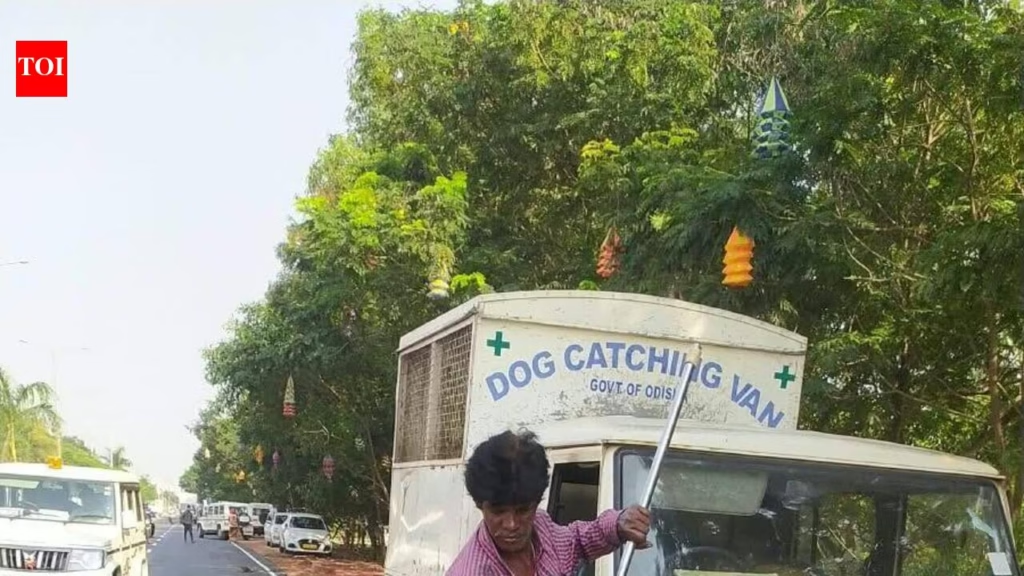
    Bhubaneswar’s BMC ran a special drive to clear stray cattle and dogs from the route taken by Prime Minister Narendra Modi on Sunday. The civic body deployed cattle‑catchers and dog‑catching squads along the stretch between Jayadev Vihar, Biju Patnaik International Airport and sections of National Highway‑16, with officials keeping constant vigilance, BMC said. Additional Commissioner Kailash Chandra Dash reported that about 50 stray cattle were caught and shifted to the Jamukoli shelter and a similar number of stray dogs were moved to kennels, adding, “Our teams were stationed at strategic locations to drive away cattle from the roads.” Animal Birth Control programme in‑charge Debi Prasad Kund said the cattle will remain in a goshala with arranged food, shelter and healthcare and will not be released back onto city roads. The action targets the chronic stray‑cattle problem that frequently blocks traffic and causes minor accidents in the state capital.

  • 6,751 dog bite cases recorded in Tambaram so far this year

    News

    6,751 dog bite cases recorded in Tambaram so far this year

    The Tambaram City Municipal Corporation (TCMC) recorded 6,751 dog-bite cases between January and Sep 2026, while vaccinating 41,485 street and pet dogs and sterilising 5,491 during a 25-day special drive, officials said. TCMC carried out the vaccination drive from August 8 across all 70 wards in its five zones, spending Rs 18 lakh from its general funds. The corporation had aimed to vaccinate 70% of the dog population but achieved much higher coverage, according to officials. A joint survey by TCMC and the World Veterinary Service estimated the corporation's total dog population at around 51,000, including an estimated 46,286 street dogs and 4,000 to 5,000 pet dogs. The drive also targeted internal and external parasites in dogs, with the goal of reducing the risk of rabies among people and animals. TCMC maintains a network of 31 urban public health institutions, including 13 urban primary health centres, stocked with anti-rabies vaccines to treat bite victims.

From the Library

  • NHAI Intensifies Measures to Prevent Accidents Caused by Stray Animals on National Highways

    Official Release

    NHAI Intensifies Measures to Prevent Accidents Caused by Stray Animals on National Highways

    The National Highways Authority of India is stepping up actions to reduce road accidents involving stray animals on national highways. As part of ongoing safety initiatives, four vulnerable locations and three accident black spots in the Chilakaluripet–Vijayawada Section of NH-16 are under continuous monitoring. Regular stray animal removal drives are being conducted across designated sections and bypasses, supported by Incident Management Teams and Route Patrol Vehicles carrying out round-the-clock patrolling. The agency also urges motorists to drive cautiously, adhere to speed limits, and report emergencies using the 24 by 7 national highway emergency helpline.

  • Government of India outlines major steps to strengthen veterinary services, expand dairy cooperatives, and manage stray dogs

    Official Release

    Government of India outlines major steps to strengthen veterinary services, expand dairy cooperatives, and manage stray dogs

    The Government of India announced on 22 Jul 2026 a set of measures aimed at bolstering veterinary services, widening the reach of dairy cooperatives, and improving the management of stray dogs across the country. The plan includes upgrading veterinary infrastructure, expanding cooperative networks for milk producers, and introducing new programs for stray-dog control and welfare. These ongoing and planned efforts seek to strengthen animal healthcare, accelerate dairy development, and enhance humane stray-dog management nationwide.

  • Government Notifies Expansion of Central Drugs Laboratory Functions at CCS NIAH, Baghpat for Veterinary Vaccine Testing

    Official Release

    Government Notifies Expansion of Central Drugs Laboratory Functions at CCS NIAH, Baghpat for Veterinary Vaccine Testing

    The Ministry of Health and Family Welfare issued a notification amending the Drugs Rules, 1945, to expand veterinary vaccine testing functions at the Central Drugs Laboratory. Published under Gazette Notification G.S.R. 65(E) on the 28 Jan 2026, under the Drugs and Cosmetics Act, 1940, the update applies to the Central Drugs Laboratory at the Chaudhary Charan Singh–National Institute of Animal Health located in Baghpat, Uttar Pradesh. The rule expands the institute's testing capacity from only two veterinary vaccines to 42 veterinary vaccines, covering biologicals used for dogs, horses, poultry and livestock. In practice, this enhancement helps streamline regulatory clearance, reduce testing timelines for manufacturers, and ensure quality-assured vaccines reach the market for animal welfare.