From letters to the Supreme Court to a year-round resource for animals. Read the story

Activists flag risks to community animals under draft lab rules

Activists flag risks to community animals under draft lab rules

Activists from Peedus People warned draft laboratory animal rules could expose community dogs, cats, cows and wildlife to experimentation during a protest at Sector 17 Plaza and Elante Mall in Chandigarh. The campaign was organized by the animal‑welfare organisation Peedus People and took place on Friday in the commercial hubs of Chandigarh, Punjab. Former Union Minister Maneka Gandhi said the proposal could allow animals to be sourced from roads, markets and unregistered establishments, while PETA India warned the draft may permit experiments on community animals and the capture of wild species under vague scientific justification. Veterinarian Dr Manish Rathee cautioned that the rules could enable backyard breeding, illegal capture and abandonment of community animals, and Sahil Sharma, president of Salute The Trees, said “Animals are living, sentient beings, not laboratory commodities to be exploited in the name of scientific progress.” The draft seeks to replace the 1968 and 1998 rules, with November 5 set as the last date for filing objections to the Committee for Control and Supervision of Experiments on Animals (CCSEA).

Sources

Read the original (opens in a new tab)Summary written by Animal Writes. Read the original before relying on it.

More in Animal Experimentation

  • Indore Metro Project: MP High Court permits tree felling, but directs phased cutting under bird experts’ supervision

    News

    Indore Metro Project: MP High Court permits tree felling, but directs phased cutting under bird experts’ supervision

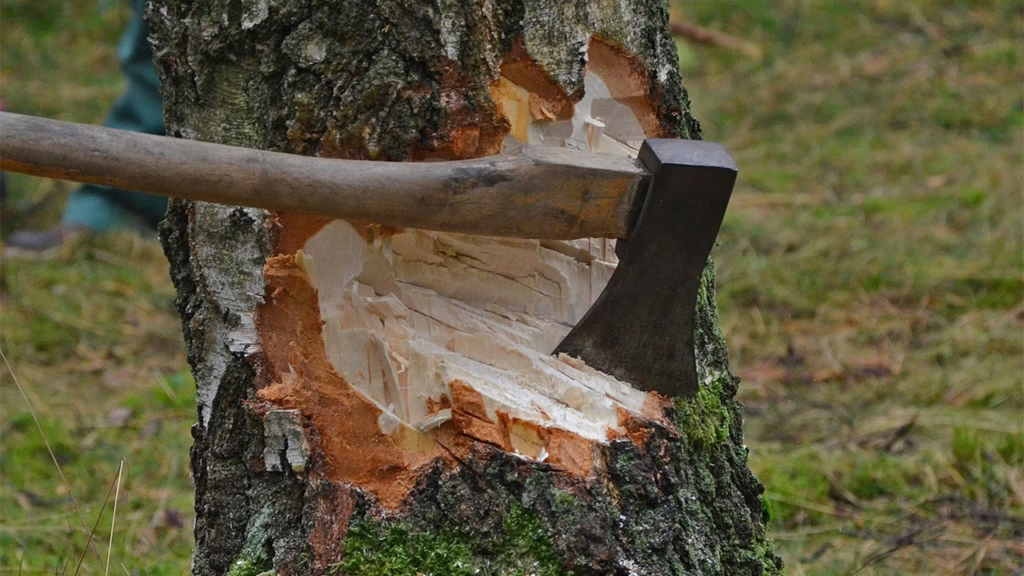
    The Madhya Pradesh High Court permitted the felling of trees for the Indore Metro project while ordering measures to protect nesting birds in Indore, Madhya Pradesh. A division bench of the High Court issued these directions in Indore after a petition raised concerns about the impact of the construction on local avian populations. The court held that the Indore Metro Rail Corporation must carry out the tree cutting in a phased manner under the supervision of bird experts. This supervision aims to ensure that no nests are destroyed during the breeding season, as the court noted the importance of balancing infrastructure development with environmental conservation. The Indore Municipal Corporation and the forest department are tasked with identifying suitable locations for transplanting trees and rehabilitating any affected wildlife. The project proponents must submit periodic compliance reports to the court to confirm that the felling adheres to the stipulated wildlife protection guidelines.
  • Activist urges govt to ban elephants at Dasara events

    News

    Activist urges govt to ban elephants at Dasara events

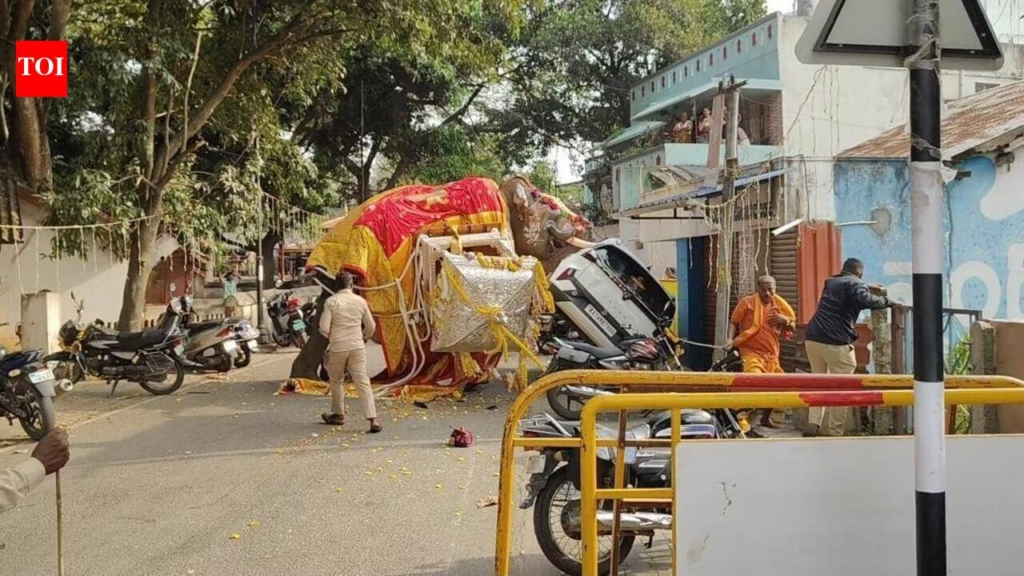
    An animal rights activist urged the government to ban elephants at Dasara events in Mysuru, Karnataka, citing animal welfare concerns. The activist stated that captive elephants suffer during such large public festivals due to loud noises, heavy crowds, and long processions. The government has not yet announced any official decision regarding the request, and authorities are expected to review the representation submitted by the activist before the next festival planning cycle begins. Animal welfare groups have frequently raised concerns over the physical and psychological toll on pachyderms used in cultural celebrations across the region. Officials from the forest department stated that they monitor the health and upkeep of participating elephants, ensuring veterinary care is provided during their stay. Public welfare bodies and citizens can write to the forest department to support humane treatment guidelines for captive elephants used in state events.

  • 6,751 dog bite cases recorded in Tambaram so far this year

    News

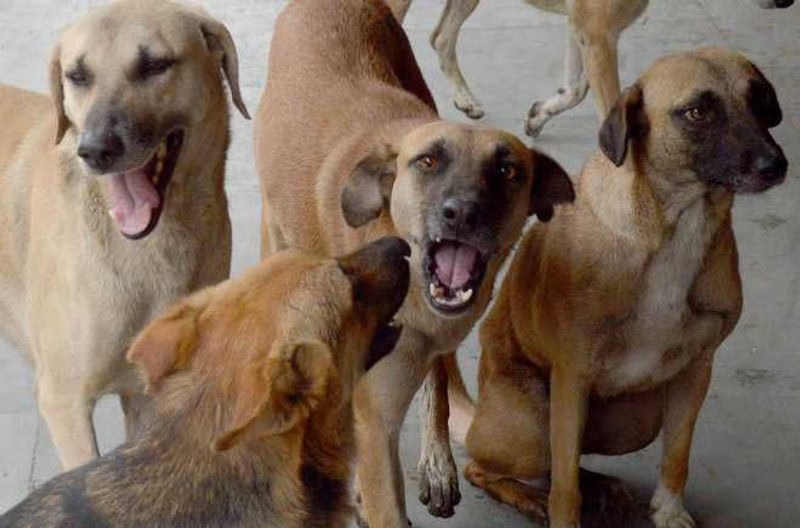
    6,751 dog bite cases recorded in Tambaram so far this year

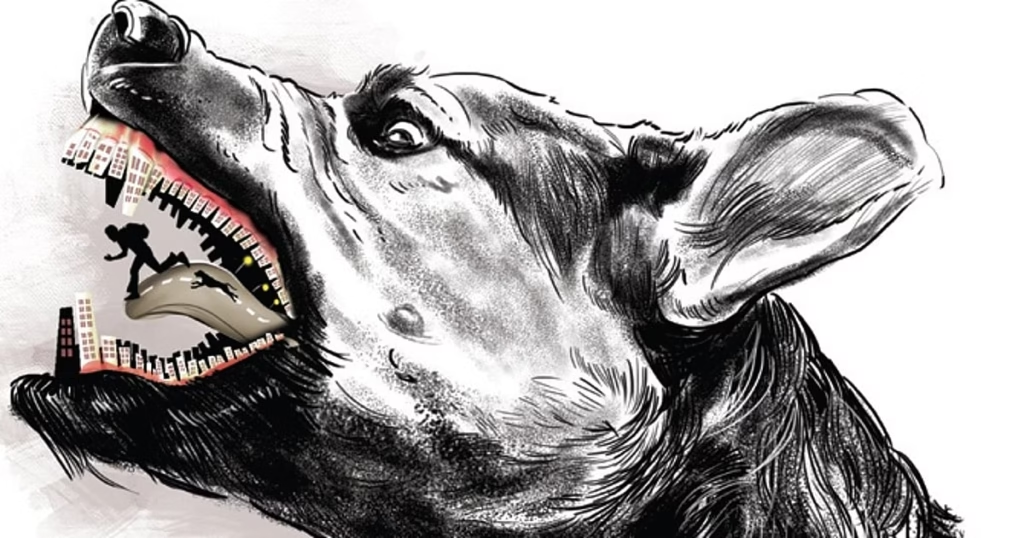
    The Tambaram City Municipal Corporation (TCMC) recorded 6,751 dog-bite cases between January and Sep 2026, while vaccinating 41,485 street and pet dogs and sterilising 5,491 during a 25-day special drive, officials said. TCMC carried out the vaccination drive from August 8 across all 70 wards in its five zones, spending Rs 18 lakh from its general funds. The corporation had aimed to vaccinate 70% of the dog population but achieved much higher coverage, according to officials. A joint survey by TCMC and the World Veterinary Service estimated the corporation's total dog population at around 51,000, including an estimated 46,286 street dogs and 4,000 to 5,000 pet dogs. The drive also targeted internal and external parasites in dogs, with the goal of reducing the risk of rabies among people and animals. TCMC maintains a network of 31 urban public health institutions, including 13 urban primary health centres, stocked with anti-rabies vaccines to treat bite victims.

From the Library

  • Draft Prevention of Cruelty to Animals (Control and Supervision of Experiment, Breeding and Trading of Laboratory Animals) Rules, 2026

    Rule

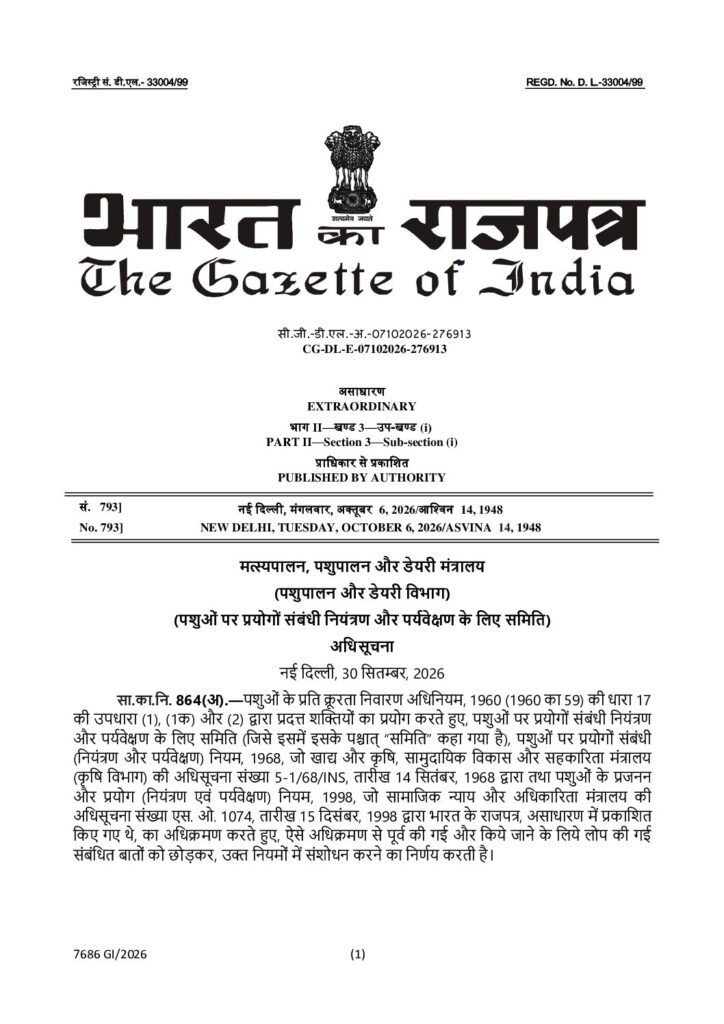
    Draft Prevention of Cruelty to Animals (Control and Supervision of Experiment, Breeding and Trading of Laboratory Animals) Rules, 2026

    The Committee for Control and Supervision of Experiments on Animals issued the Draft Laboratory Animals Rules, 2026 under the Prevention of Cruelty to Animals Act, 1960. The notification, issued on 30 Sep 2026, sets out updated standards for scientific and educational experiments involving animals. The new framework will replace India's older 1968 and 1998 rules on experiments on animals. Under the proposed system, each experiment would be classed as non-recovery, mild, moderate or severe. A laboratory's own institutional animal ethics committee would be permitted to approve mild and moderate procedures. The Committee for Control and Supervision of Experiments on Animals would retain approval authority for severe and non-recovery procedures performed on animals positioned above rodents and rabbits. Some farm animals, fish and birds could come from the open market with the approval of the ethics committee. The public and interested stakeholders can send formal objections or suggestions regarding the draft text to the Committee for Control and Supervision of Experiments on Animals until 5 Nov 2026.

  • Page 1 of Strict compliance with the directions of the Hon’ble Supreme Court in Suo Motu Writ Petition (Civil) No. 5 of 2025, In Re: City Hounded by Strays, Kids Pay Price, the Standard Operating Procedures issued by the Animal Welfare Board of India dated 27.11.2025 and the Animal Birth Control Rules, 2023.

    Circular

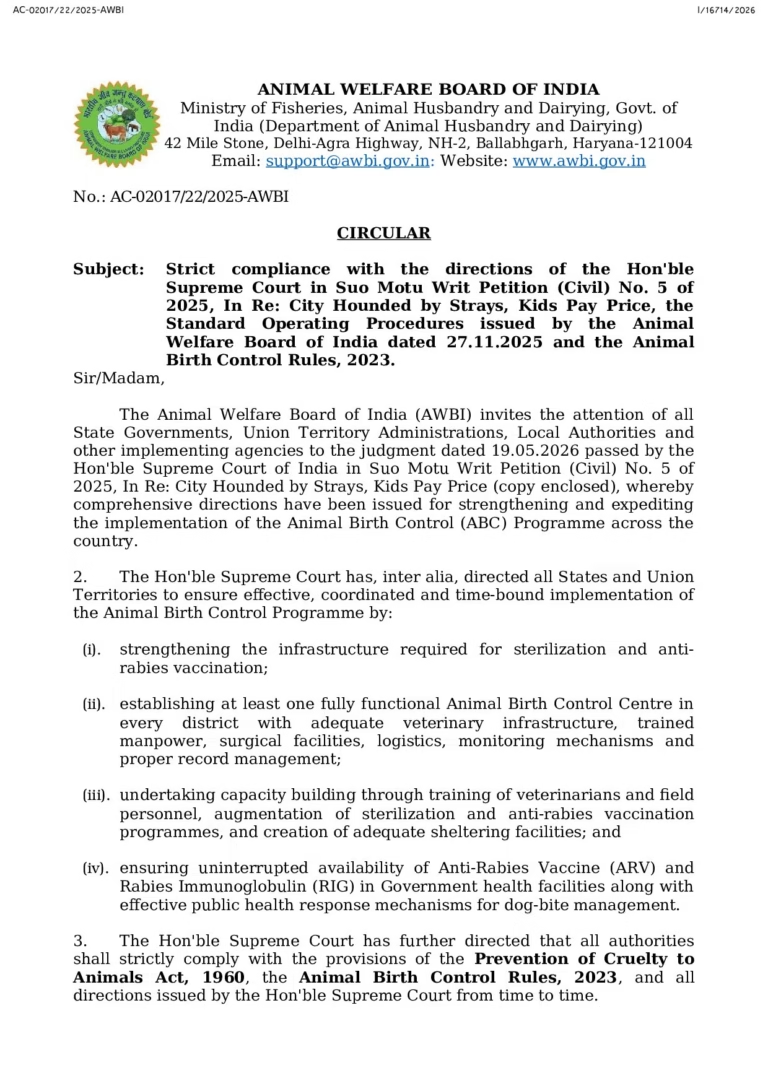
    Strict compliance with the directions of the Hon’ble Supreme Court in Suo Motu Writ Petition (Civil) No. 5 of 2025, In Re: City Hounded by Strays, Kids Pay Price, the Standard Operating Procedures issued by the Animal Welfare Board of India dated 27.11.2025 and the Animal Birth Control Rules, 2023.

    The Animal Welfare Board of India issued a circular requiring strict adherence to stray dog management regulations. The notice mandates compliance with Supreme Court of India orders from a 2025 case, the board's standard operating procedures, and the Animal Birth Control Rules, 2023. These directions apply to all state governments, union territory administrations, local authorities, and implementing agencies across the country.

  • Administrative (Committee for Control and Supervision of Experiments on Animals) Amendment Rules, 2026

    Rule

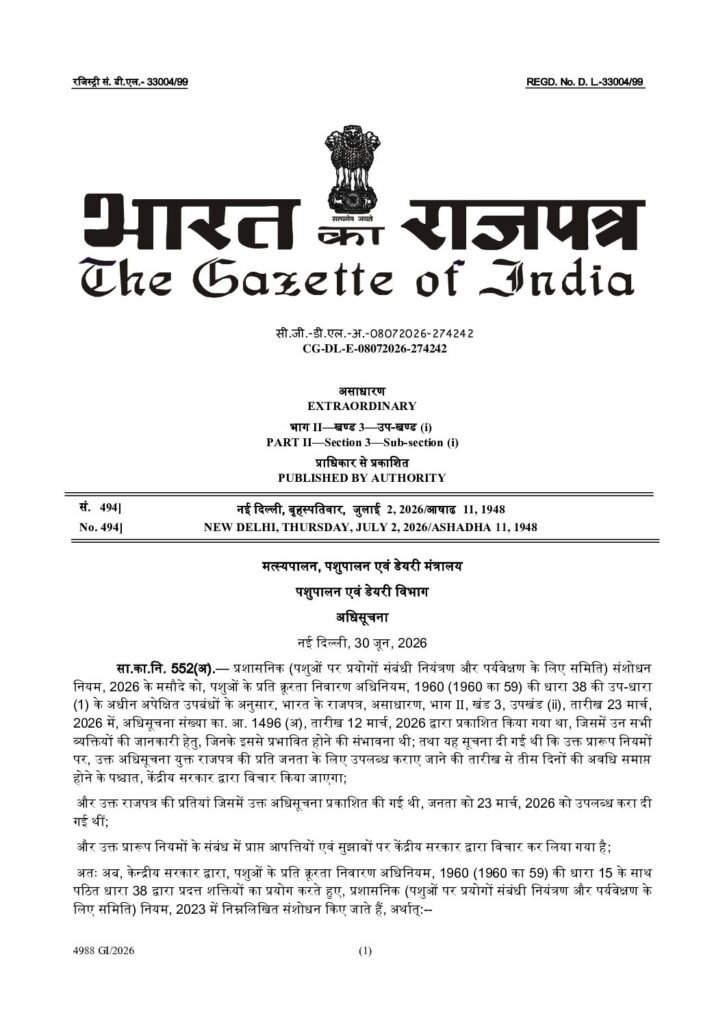
    Administrative (Committee for Control and Supervision of Experiments on Animals) Amendment Rules, 2026

    The Ministry of Fisheries, Animal Husbandry and Dairying issued notification G.S.R. 552(E), setting CCSEA's fees for registering animal facilities, breeding, renewal, ethics committee revision, and protocols on large animals. Published in the Gazette of India under the Prevention of Cruelty to Animals Act, 1960, the document establishes processing fees of 12,000 rupees for small and large animal registration and small animal facility amendments. Breeding registration for in-house use costs 18,000 rupees for small animals and 30,000 rupees for large animals, while trade breeding is 30,000 rupees for both. Renewal costs 3,000 rupees, revision of the Institutional Animal Ethics Committee is 1,200 rupees, and large animal educational protocols cost 1,200 rupees per protocol, with non-educational protocols costing 6,000 rupees.