
From letters to the Supreme Court to a year-round resource for animals. Read the story

ASSESSMENT OF ANIMAL WELFARE MANAGEMENT PRACTICES AMONG LIVESTOCK FARMERS

ASSESSMENT OF ANIMAL WELFARE MANAGEMENT PRACTICES AMONG LIVESTOCK FARMERS

The study found an overall Animal Welfare Index of 65.09 among dairy and sheep‑goat livestock farmers in Tirunelveli district. The research, published in the Indian Journal of Veterinary and Animal Sciences Research, randomly selected six blocks in the district, formed one focus group per block and surveyed 10 farmers from each group, giving a total sample of 60 respondents – 30 dairy farmers and 30 sheep and goat farmers. The authors reported that the highest sub‑index was for appropriate animal behaviour at 79.72, followed by good housing at 77.50, good feeding at 59.83, and good health at 49.16. Multiple linear regression analysis showed that education, experience in livestock farming, contact with extension agencies and participation in training programmes each had a positive highly significant influence (p < 0.01) on adoption of animal‑welfare practices, while exposure to mass media had a positive significant influence (p < 0.05). The authors recommend focused training programmes and mass‑awareness campaigns on existing animal‑welfare standards to improve animal wellbeing and promote sustainable livestock farming among farming communities.

Questions about the livestock farmers study in Tirunelveli

Animal welfare FAQ

M. Gunaseelan, R.V. Mervin Kennady and M. Mukilan carried out the study, titled “Assessment of Animal Welfare Management Practices Among Livestock Farmers”. Read the study.

The study was published in Indian Journal of Veterinary and Animal Sciences Research on . See it in the journal.

The study found an overall Animal Welfare Index of 65.09 among dairy and sheep‑goat livestock farmers in Tirunelveli district. Read the full study.

Sources

Study: ASSESSMENT OF ANIMAL WELFARE MANAGEMENT PRACTICES AMONG LIVESTOCK FARMERS by M. Gunaseelan, R.V. Mervin Kennady and M. Mukilan in Indian Journal of Veterinary and Animal Sciences Research Read the original (opens in a new tab)

Summary written by Animal Writes. Read the original before relying on it.

More research

  • Human Wildlife Conflict in Kerala: Spatial Patterns and Community Perceptions in Selected Forest Fringe Areas

    Research

    Human Wildlife Conflict in Kerala: Spatial Patterns and Community Perceptions in Selected Forest Fringe Areas

    A study found Wayanad district accounted for 17 of 42 recorded human deaths from human-wildlife conflict in Kerala between 2021 and 2025, with Asian elephants linked to 27 fatalities. Researchers from CHRIST (Deemed to be University) in Bengaluru mapped fatalities using newspaper archives and GIS tools and conducted structured interviews with 50 residents in Mulli, Sholayur and settlements near Chimmini Dam during the same period. The authors found avoidance of night-time outdoor movement (mean score 4.22) and worry for family safety (3.84) were common fear responses, while sleep disturbance scored 3.24. Educational impacts were limited among ten respondents with school-going children. Compensation awareness varied from 30.8% among those without formal schooling to 83.3% among graduates, and low awareness made up 42.1% of 76 cited insurance barriers. Forest Department incident response rated 4.38 versus 2.24 for government conflict-control measures. The researchers suggest regular upkeep of preventive infrastructure and clearer information on financial support schemes deserve attention.
  • Rabies surveillance in India needs integrated system, study finds

    Research

    Rabies surveillance in India needs integrated system, study finds

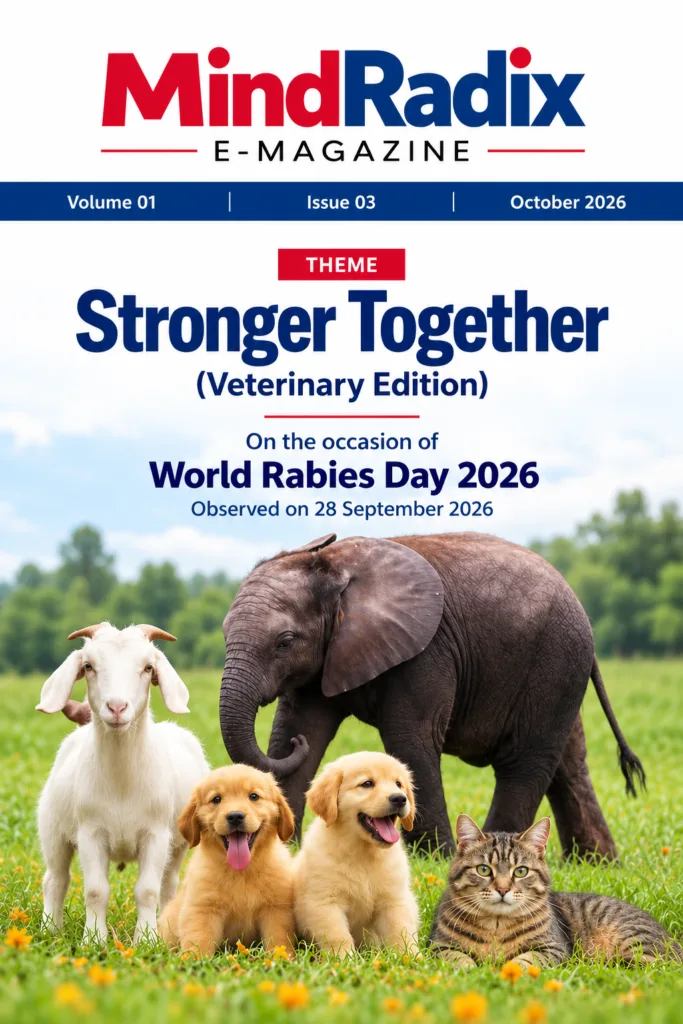
    An effective rabies surveillance system in India must connect multiple elements early enough to ensure a prompt response. The analysis published in Volume 1 Issue 3 across pages 25 to 41 argues that rabies surveillance must connect bite incidents, animal tracking, laboratory data, treatment pathways, vaccination campaigns and geographic locations early enough for an effective response. India already holds important pieces of this architecture. The next step described by the authors is making these components interoperable, timely and useful at the district level. They describe a system that should not merely count cases after they occur, but instead integrate data flows across the entire prevention and response chain. The article frames this integration as essential for moving away from reactive case counting toward proactive surveillance that can guide interventions where they are needed most.

From the Library

  • AI tool to monitor hill cattle herds

    Official Release

    AI tool to monitor hill cattle herds

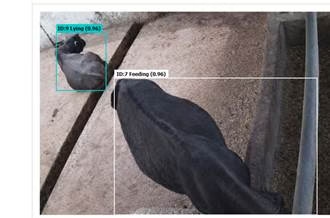
    India’s Press Information Bureau announced that an artificial-intelligence system has been introduced to monitor cattle grazing in hilly regions. The technology uses sensors and imaging to track herd movements and health, providing farmers with real-time data on their animals. Developed by researchers at the ICAR-National Research Centre on Mithun in Nagaland, the system uses 12 high-definition CCTV cameras across two sheds for continuous day-and-night surveillance. Using a dataset of 3,000 manually annotated images, the AI framework combines the YOLOv8n model with DeepSORT technology to track individual animals in real time.

  • Government steps on vet services, dairy and stray dogs

    Official Release

    Government steps on vet services, dairy and stray dogs

    The Government of India announced on 22 Jul 2026 a set of measures aimed at bolstering veterinary services, widening the reach of dairy cooperatives, and improving the management of stray dogs across the country. The plan includes upgrading veterinary infrastructure, expanding cooperative networks for milk producers, and introducing new programs for stray-dog control and welfare. These ongoing and planned efforts seek to strengthen animal healthcare, accelerate dairy development, and enhance humane stray-dog management nationwide.

  • Page 1 of Strict compliance with the directions of the Hon’ble Supreme Court in Suo Motu Writ Petition (Civil) No. 5 of 2025

    Circular

    Stray dog orders and ABC Rules: AWBI compliance circular

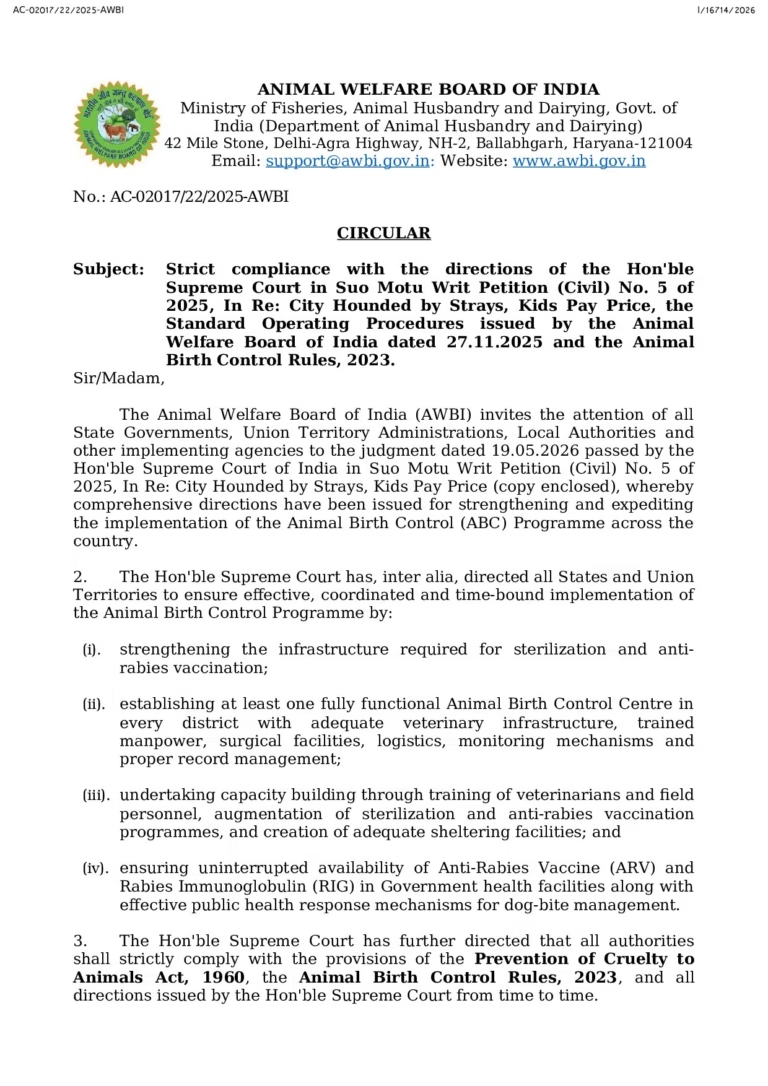
    The Animal Welfare Board of India issued a circular requiring strict adherence to stray dog management regulations. The notice mandates compliance with Supreme Court of India orders from a 2025 case, the board's standard operating procedures, and the Animal Birth Control Rules, 2023. These directions apply to all state governments, union territory administrations, local authorities, and implementing agencies across the country.

Get Animal Writes updates

News, important developments and practical guides — no spam.

Newsletter

Email me Animal Writes updates. I can unsubscribe at any time.