
From letters to the Supreme Court to a year-round resource for animals. Read the story

What Ahmedabad health workers know about rabies vaccines

What Ahmedabad health workers know about rabies vaccines

A new study on stray dogs and rabies prevention in Ahmedabad Municipal Corporation assessed 139 Accredited Social Health Activists to measure their knowledge about animal bites and post-exposure care. The cross-sectional study was carried out by researchers using a self-administering questionnaire among workers selected from urban primary health centres between and . The study participants had a mean age of 43.8 years and a mean work experience of 11.6 years. None of the surveyed workers had received prior training in rabies or wound care. The researchers found that 92.1 per cent of participants recognized dog bites as a source of rabies, while 82 per cent knew the disease is fatal. Nearly all participants, or 97.1 per cent, knew about the rabies vaccine, but only 20 per cent knew the correct number of doses required. The survey also found that 62.6 per cent of the workers believed in traditional remedies for wound care. Meanwhile, 76.3 per cent of the participants knew about washing the wound with soap and water. Total knowledge scores showed the strongest association with work experience among the participants. The authors stated that “this study identifies lack of knowledge regarding Rabies and appropriate care of wounds.”

Questions about the rabies vaccine study in Ahmedabad

Animal welfare FAQ

Vibhuti Chandera, Bhavna Puwar, Vaibhavi Patel and others carried out the study, titled “Knowledge of Rabies and Wound Care after Animal Bite among Accredited Social Health Activists (ASHA) in Ahmedabad Municipal Corporation (AMC): A Cross-Sectional Study”. Read the study.

The study was published in Healthline on . See it in the journal.

A new study on stray dogs and rabies prevention in Ahmedabad Municipal Corporation assessed 139 Accredited Social Health Activists to measure their knowledge about animal bites and post-exposure care. Read the full study.

Sources

Study: Knowledge of Rabies and Wound Care after Animal Bite among Accredited Social Health Activists (ASHA) in Ahmedabad Municipal Corporation (AMC): A Cross-Sectional Study by Vibhuti Chandera, Bhavna Puwar, Vaibhavi Patel et al. in Healthline Read the original (opens in a new tab)

Summary written by Animal Writes. Read the original before relying on it.

More research

  • Human Wildlife Conflict in Kerala: Spatial Patterns and Community Perceptions in Selected Forest Fringe Areas

    Research

    Human Wildlife Conflict in Kerala: Spatial Patterns and Community Perceptions in Selected Forest Fringe Areas

    A study found Wayanad district accounted for 17 of 42 recorded human deaths from human-wildlife conflict in Kerala between 2021 and 2025, with Asian elephants linked to 27 fatalities. Researchers from CHRIST (Deemed to be University) in Bengaluru mapped fatalities using newspaper archives and GIS tools and conducted structured interviews with 50 residents in Mulli, Sholayur and settlements near Chimmini Dam during the same period. The authors found avoidance of night-time outdoor movement (mean score 4.22) and worry for family safety (3.84) were common fear responses, while sleep disturbance scored 3.24. Educational impacts were limited among ten respondents with school-going children. Compensation awareness varied from 30.8% among those without formal schooling to 83.3% among graduates, and low awareness made up 42.1% of 76 cited insurance barriers. Forest Department incident response rated 4.38 versus 2.24 for government conflict-control measures. The researchers suggest regular upkeep of preventive infrastructure and clearer information on financial support schemes deserve attention.


  • Rabies surveillance in India needs integrated system, study finds

    Research

    Rabies surveillance in India needs integrated system, study finds

    An effective rabies surveillance system in India must connect multiple elements early enough to ensure a prompt response. The analysis published in Volume 1 Issue 3 across pages 25 to 41 argues that rabies surveillance must connect bite incidents, animal tracking, laboratory data, treatment pathways, vaccination campaigns and geographic locations early enough for an effective response. India already holds important pieces of this architecture. The next step described by the authors is making these components interoperable, timely and useful at the district level. They describe a system that should not merely count cases after they occur, but instead integrate data flows across the entire prevention and response chain. The article frames this integration as essential for moving away from reactive case counting toward proactive surveillance that can guide interventions where they are needed most.

  • Only 55.1% take all 4 rabies vaccine doses in Chengalpattu

    Research

    Only 55.1% take all 4 rabies vaccine doses in Chengalpattu

    A study of 301 animal bite victims at an urban health training centre in Chengalpattu district, Tamil Nadu, found only 55.1 percent completed all four anti-rabies vaccine doses. The researchers recorded that 70.8 percent of the victims received at least three doses of the vaccine. Only 5 percent of the bite victims washed the wound with soap and water and applied an antiseptic after the exposure. Loss of wages and forgotten dates emerged as the most common reasons cited for missed vaccine doses. The study also noted that 83.4 percent of the victims followed food restrictions after the bite incident. The authors observed low adherence to proper wound management and incomplete vaccination schedules among patients attending the urban health training centre. They suggested that awareness gaps and socioeconomic barriers contribute to missed doses and inadequate first aid. The findings indicate a need for improved patient counselling and follow-up systems at the facility. The researchers recommended targeted health education to address wound care practices and vaccination completion rates in the community.

From the Library

  • NHAI steps to stop stray animal accidents on highways

    Official Release

    NHAI steps to stop stray animal accidents on highways

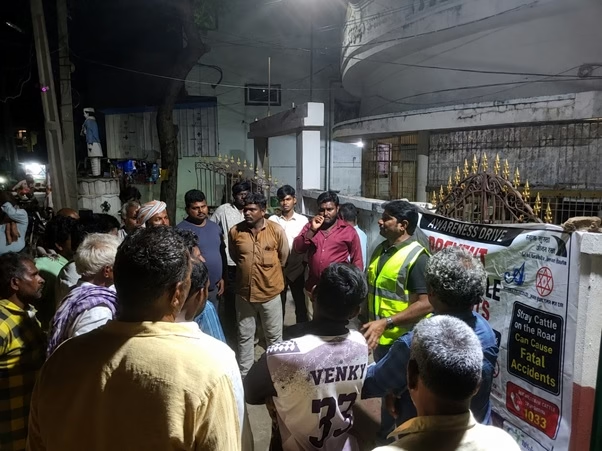
    The National Highways Authority of India is stepping up actions to reduce road accidents involving stray animals on national highways. As part of ongoing safety initiatives, four vulnerable locations and three accident black spots in the Chilakaluripet–Vijayawada Section of NH-16 are under continuous monitoring. Regular stray animal removal drives are being conducted across designated sections and bypasses, supported by Incident Management Teams and Route Patrol Vehicles carrying out round-the-clock patrolling. The agency also urges motorists to drive cautiously, adhere to speed limits, and report emergencies using the 24 by 7 national highway emergency helpline.

  • Government steps on vet services, dairy and stray dogs

    Official Release

    Government steps on vet services, dairy and stray dogs

    The Government of India announced on 22 Jul 2026 a set of measures aimed at bolstering veterinary services, widening the reach of dairy cooperatives, and improving the management of stray dogs across the country. The plan includes upgrading veterinary infrastructure, expanding cooperative networks for milk producers, and introducing new programs for stray-dog control and welfare. These ongoing and planned efforts seek to strengthen animal healthcare, accelerate dairy development, and enhance humane stray-dog management nationwide.

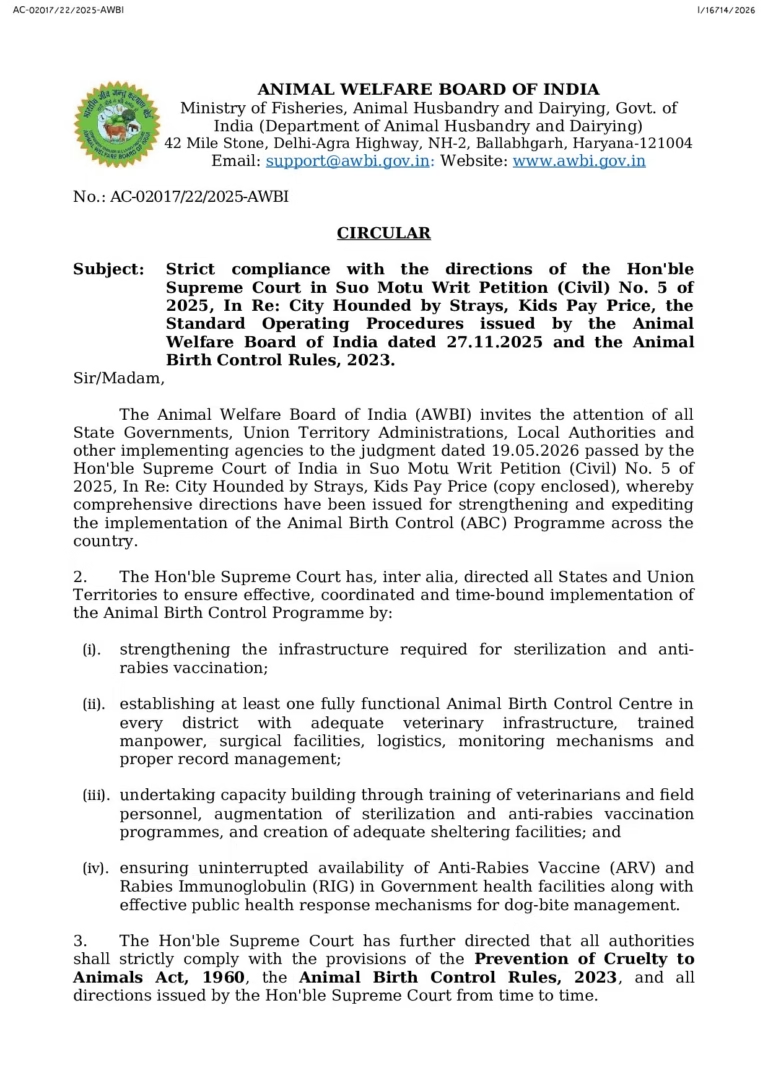
  • Page 1 of Strict compliance with the directions of the Hon’ble Supreme Court in Suo Motu Writ Petition (Civil) No. 5 of 2025

    Circular

    Stray dog orders and ABC Rules: AWBI compliance circular

    The Animal Welfare Board of India issued a circular requiring strict adherence to stray dog management regulations. The notice mandates compliance with Supreme Court of India orders from a 2025 case, the board's standard operating procedures, and the Animal Birth Control Rules, 2023. These directions apply to all state governments, union territory administrations, local authorities, and implementing agencies across the country.

Get Animal Writes updates

News, important developments and practical guides — no spam.

Newsletter

Email me Animal Writes updates. I can unsubscribe at any time.