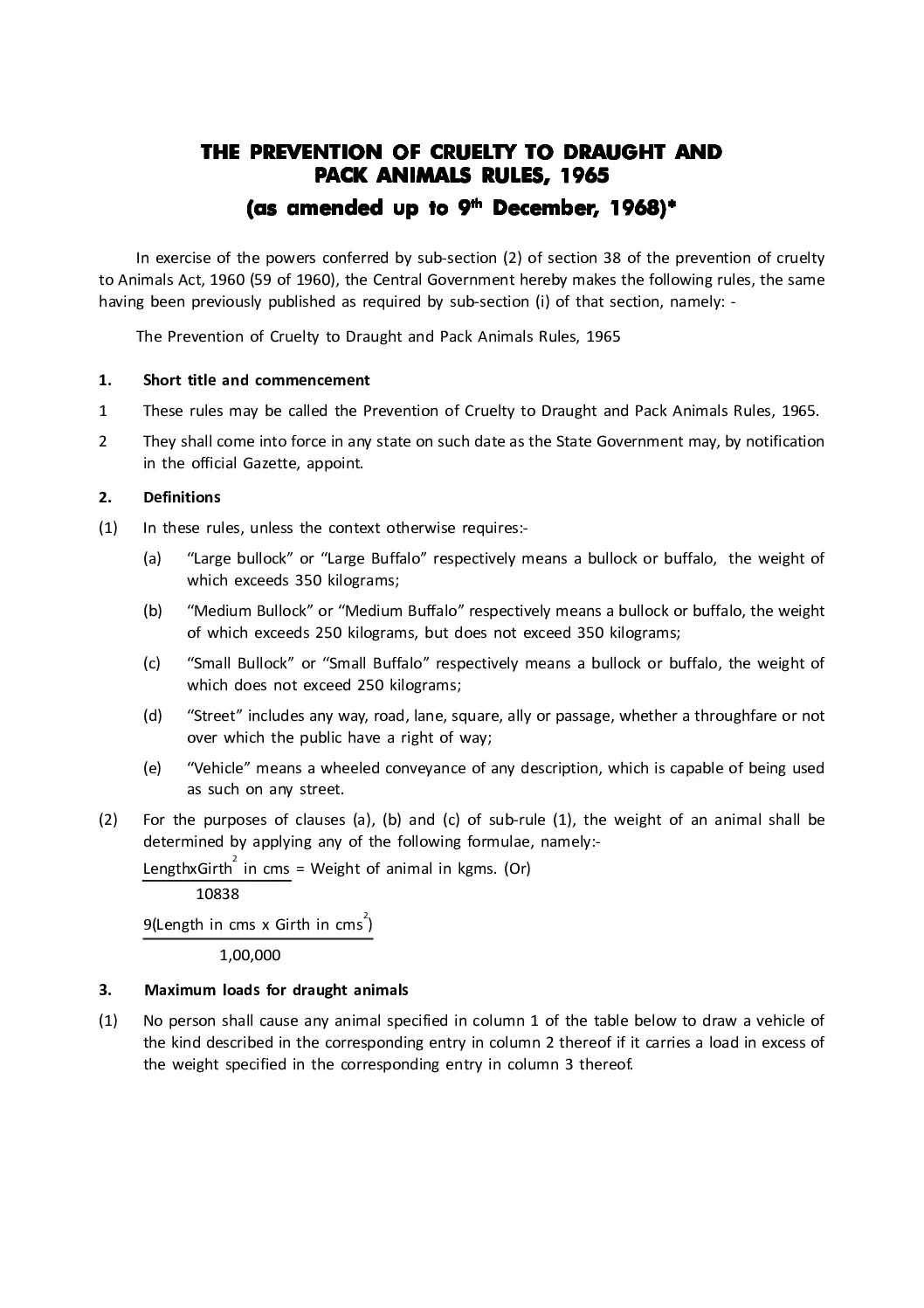
The Draught and Pack Animals Rules, 1965 set the most weight a working animal may pull or carry in India and how long it may work. The Central Government made them on under section 38 of the Prevention of Cruelty to Animals Act, 1960, and amended them on . A bullock or buffalo may pull a two-wheeled cart of at most 500 to 1,800 kg, depending on its weight class (up to 250 kg, 250 to 350 kg, or over 350 kg) and the cart’s wheels; a horse or mule 500 to 750 kg, a pony 400 to 600 kg, and a camel 1,000 kg. On a climb of a kilometre or more that rises over three metres in thirty, the limit is halved. As a pack animal, a donkey may carry at most 50 kg, a pony 70 kg, a bullock or buffalo 100 to 175 kg, a mule 200 kg and a camel 250 kg. No animal may work more than nine hours a day, more than five hours without rest, or between noon and 3 pm where it is hotter than 37°C. Spiked sticks, bits and yokes are banned, and an animal must be unharnessed once its work is done. A cart may carry at most four passengers, not counting the driver and children under six. A police officer above the rank of constable can have the load weighed at a nearby weighbridge. The rules apply in a state from the date its government notifies them. If you see an overloaded cart or a donkey made to work in the midday heat, these rules are the ones to cite in a complaint.
The Draught and Pack Animals Rules, 1965 were notified on as No. 9-18/62-LD.
Section 3 of the Draught and Pack Animals Rules, 1965 provides the most a bullock, buffalo, horse, mule, pony or camel may pull, by the animal's weight class and the cart's wheels. Read the full section.
Section 4 of the Draught and Pack Animals Rules, 1965 provides the most a pack animal may carry: donkey 50 kg, pony 70 kg, bullock or buffalo 100 to 175 kg, mule 200 kg, camel 250 kg. Read the full section.
Section 6 of the Draught and Pack Animals Rules, 1965 provides no work for more than nine hours a day, five hours without rest, or from noon to 3 pm above 37°C. Read the full section.
The Committee for Control and Supervision of Experiments on Animals issued the Draft Laboratory Animals Rules, 2026 under the Prevention of Cruelty to Animals Act, 1960. The notification, issued on…
The Ministry of Fisheries, Animal Husbandry and Dairying issued Notification G.S.R. 552(E) on 30 Jun 2026, a fee schedule under the Prevention of Cruelty to Animals Act, 1960 that sets…
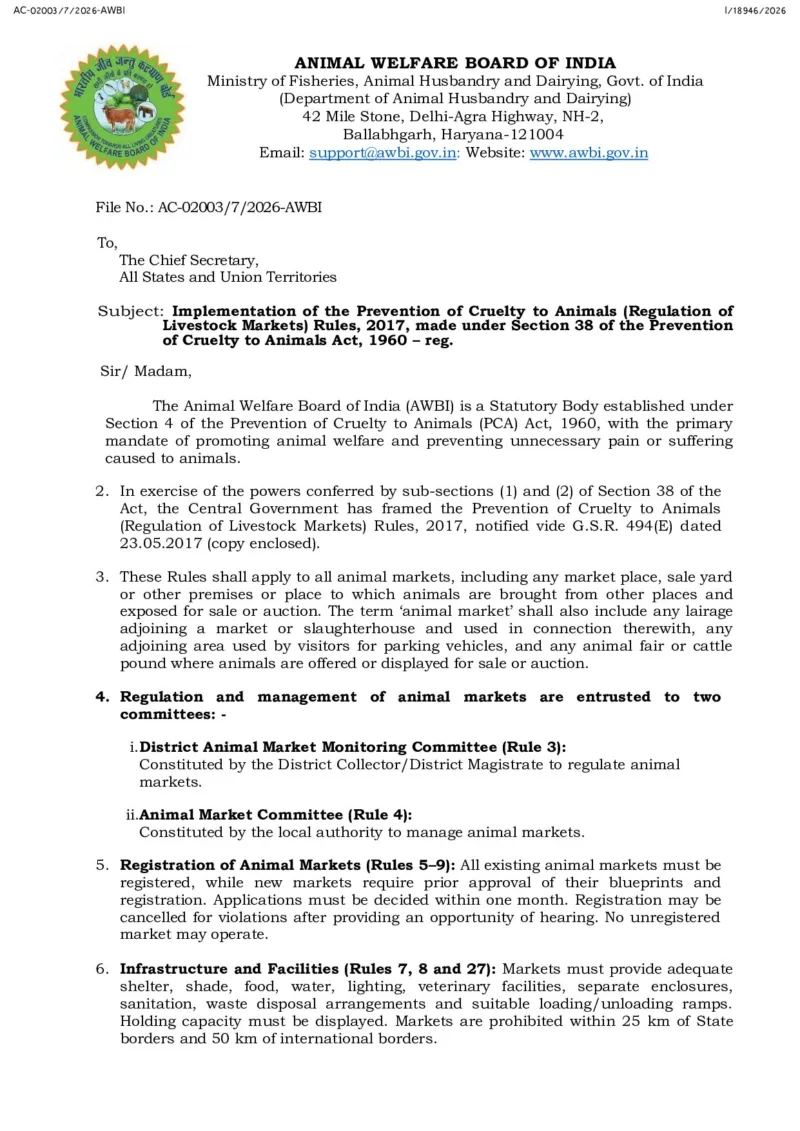
The Animal Welfare Board of India issued a circular directing the implementation of the Prevention of Cruelty to Animals (Regulation of Livestock Markets) Rules, 2017, for all livestock market authorities.…
West Bengal Chief Minister Suvendu Adhikari stated that cow slaughter would be prevented in the state through strict enforcement of the West Bengal Animal Slaughter Control Act, 1950, and relevant…
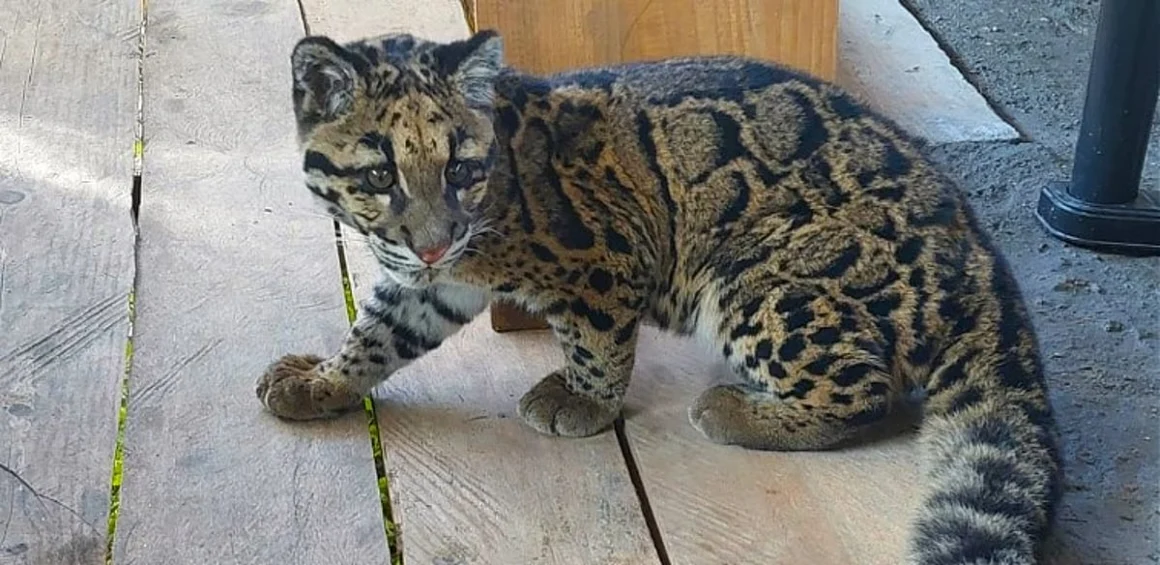
A Schedule I protected clouded leopard was rescued near Senge village in West Kameng district, Arunachal Pradesh. The Bomdila Forest Division acted after receiving tips about the wild animal, carrying…
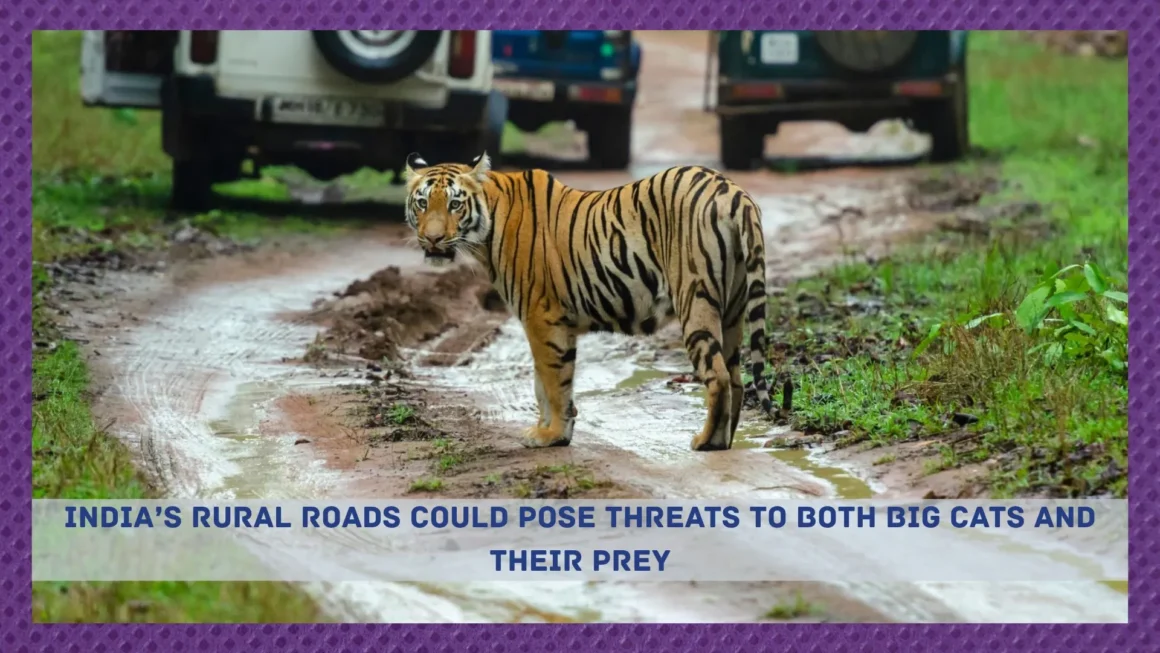
Rural roads in central India’s tiger heartland pose severe danger to tigers, leopards and their prey, a new study finds. Researchers from the Wildlife Institute of India analysed 32,500 km…