
From letters to the Supreme Court to a year-round resource for animals. Read the story

The Wild Life (Protection) Act, 1972

The Wild Life (Protection) Act, 1972

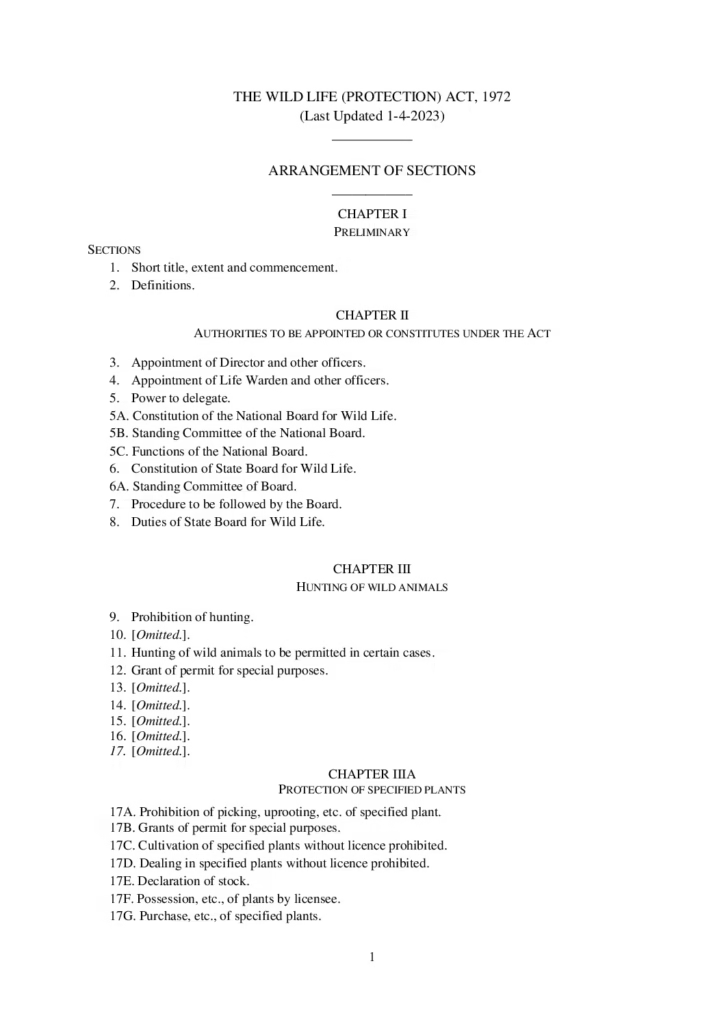
The Wild Life (Protection) Act, 1972 (Act No. 53 of 1972, dated ) is India’s principal statute for conserving, protecting and managing wild animals and plants. It applies to the Union and State governments, wildlife authorities, hunters, traders, zoos, the Central Zoo Authority, the National Tiger Conservation Authority, the Wildlife Crime Control Bureau and any person dealing with wildlife. The Act bans hunting of species listed in its Schedules — the Schedules being the official lists of protected wildlife — and makes any wild animal taken in contravention of the law government property. Section 39 states, “wild animals taken contrary to the Act shall be property of the Government.” It also regulates trade in animal articles and trophies (Chapter V) and, since amendments up to 2022, extends to international trade under CITES and to invasive alien species (Section 62A). In practice, hunters must obtain a permit for any capture of a scheduled animal; traders need licences to deal in trophies or animal articles; zoos must be recognised by the Central Zoo Authority before acquiring animals; and any import, export or re‑export of scheduled specimens requires a licence issued by the designated management authority. For community animal feeders and the public, the Act means they must ensure that stray or community dogs they care for are not listed species and that no wildlife is moved or sold without the required permissions.

Act No. 53 of 1972 PDF

Your browser cannot show this PDF here. Use the download link below.

Download PDF (2.7 MB)

Questions about Wildlife Protection Act 1972

Animal welfare FAQ

Download the official Wild Life (Protection) Act, 1972 PDF here.

Yes. The Wildlife Protection Act 1972 is in force. Read the official text.

The Wildlife Protection Act 1972 was notified on as Act No. 53 of 1972.

Section 9 of the Wildlife Protection Act 1972 provides no one may hunt a wild animal listed in Schedule I or II, except under the permits in sections 11 and 12. Read the full section.

Section 39 of the Wildlife Protection Act 1972 provides a wild animal hunted, kept or bred against the Act, or found dead, and the vehicles, weapons and traps used in the offence, are the property of the Government. Read the full section.

Section 49B of the Wildlife Protection Act 1972 provides no one may deal in articles, trophies, meat or captive animals from scheduled animals, or cook or serve the meat of a scheduled animal in an eating-house. Read the full section.

Sources

Read the original (opens in a new tab)Summary written by Animal Writes. Read the original before relying on it.

More in Laws and Rules

  • 45 live reptiles seized at Trichy airport, 2 arrested

    Official Release

    45 live reptiles seized at Trichy airport, 2 arrested

    The Directorate of Revenue Intelligence issued a seizure report detailing how officers foiled an attempt to smuggle live reptiles into India at Trichy Airport. The action applies to international passengers and wildlife smugglers operating through airports. According to Free Press Journal, officers intercepted two Indian passengers arriving from Bangkok via Colombo on 26 Oct 2026. A systematic examination of passenger baggage led to the recovery of forty-five live reptiles concealed inside twenty-seven food packets while the sedated animals remained hidden. The seized animals comprised twenty-three Corn Snakes, sixteen Ball Pythons, five Argentine Black and White Tegus, and one Snow White Iguana. Two passengers faced arrest by the Air Intelligence Unit, Trichy, under the provisions of the Customs Act, 1962, and the recovered wildlife went to the unit for further necessary action. In practice, this means travellers attempting to transport animals illegally face baggage searches, confiscation of concealed wildlife, and arrest under federal customs laws. Readers can report suspected wildlife trafficking activity to customs authorities and airport intelligence units.

  • A thick stack of printed papers on a wooden desk by a window, with a binder clip and a pencil beside it.

    Rule

    Draft Prevention of Cruelty to Animals (Control and Supervision of Experiment, Breeding and Trading of Laboratory Animals) Rules, 2026 (GSR 864E)

    The Committee for Control and Supervision of Experiments on Animals issued the Draft Laboratory Animals Rules, 2026 under the Prevention of Cruelty to Animals Act, 1960. The notification, issued on 30 Sep 2026, sets out updated standards for scientific and educational experiments involving animals. The new framework will replace India's older 1968 and 1998 rules on experiments on animals. Under the proposed system, each experiment would be classed as non-recovery, mild, moderate or severe. A laboratory's own institutional animal ethics committee would be permitted to approve mild and moderate procedures. The Committee for Control and Supervision of Experiments on Animals would retain approval authority for severe and non-recovery procedures performed on animals positioned above rodents and rabbits. Some farm animals, fish and birds could come from the open market with the approval of the ethics committee. The public and interested stakeholders can send formal objections or suggestions regarding the draft text to the Committee for Control and Supervision of Experiments on Animals until 5 Nov 2026.

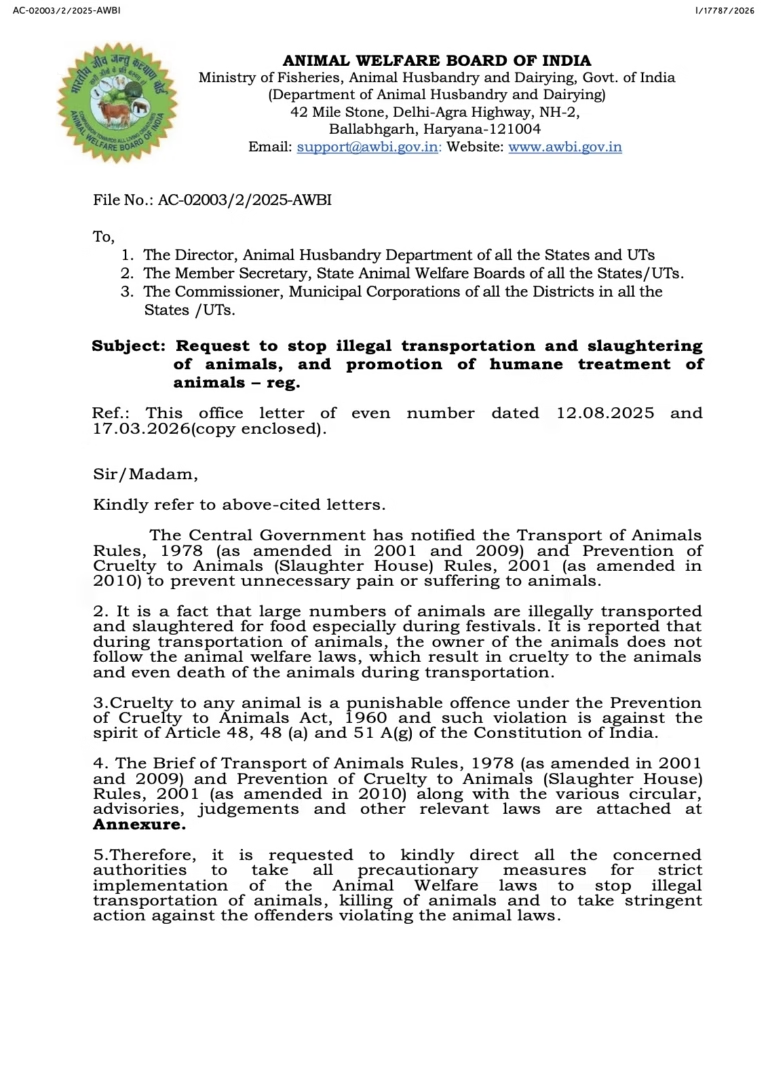
  • First page of the AWBI letter asking states to stop illegal transport and slaughter of animals, linked to 14 September 2026

    Circular

    Illegal transport and slaughter: AWBI circular, 14 Sep 2026

    The Animal Welfare Board of India issued a circular requesting an end to the unlawful transport and slaughter of animals. The notification also urged the humane treatment of animals, noting that large numbers of animals are illegally transported and slaughtered for food especially during festivals. The Animal Welfare Board of India stated that owner negligence during transport leads to cruelty and even death, which constitutes a punishable offence under the Prevention of Cruelty to Animals Act, 1960. The document bears file number AC-02003/2/2025-AWBI.

News about this

  • Nahargarh Wildlife Sanctuary boundary dispute: Supreme Court asks activist to pursue challenge to revised map before Rajasthan High Court

    News

    Nahargarh Wildlife Sanctuary boundary dispute: Supreme Court asks activist to pursue challenge to revised map before Rajasthan High Court

    The Supreme Court on 3 November refused to rule on a challenge to the revised boundaries of Rajasthan’s Nahargarh Wildlife Sanctuary, directing activist Rajendra Tiwari to raise his objections before the Rajasthan High Court, where the map is already contested. The bench of Chief Justice of India Surya Kant and Justices Joymalya Bagchi and V. Mohana noted that “the controversy surrounding the identification and demarcation of the sanctuary’s actual boundaries must first be adjudicated by the High Court.” The dispute stems from National Green Tribunal proceedings over the inclusion of the revenue area of village Nahargarh in the protected zone, which the Forest Department altered without the National Board for Wildlife’s approval, according to Tiwari’s claim. The Supreme Court observed that the High Court’s pending case will determine any illegality and bind all parties, including government authorities, once its decision becomes final. Tiwari may now pursue all remaining objections in the High Court.

  • Call to reduce laboratory animal use is not driven by ethics alone

    News

    Call to reduce laboratory animal use is not driven by ethics alone

    On October 6, the Ministry of Fisheries, Animal Husbandry and Dairying proposed the Draft Laboratory Animals Rules, 2026 under the Prevention of Cruelty to Animals Act, 1960, raising concerns over laboratory animal use in India. The ministry stated that the new rules aim to update standards for scientific and educational experiments involving animals. Critics argued that three provisions of the draft contradict the 3R principles of replacement, reduction, and refinement. Rule 4(6) permits the use of animals in teaching laboratories that phased out dissection over a decade ago under University Grants Commission guidelines. Rule 5 creates exceptions allowing species protected under the Wildlife (Protection) Act, 1972, as well as free-ranging and feral animals, to be used in experiments and training, while Rule 21(2) allows sourcing from unregistered establishments and open markets. Observers stated that these provisions threaten biodiversity, risk ecological disruption, and conflict with modern non-animal technologies and advancements in human-specific cell and gene therapies.

  • PETA India aids rescue of trafficked monitor lizards in Sadashivpet

    News

    PETA India aids rescue of trafficked monitor lizards in Sadashivpet

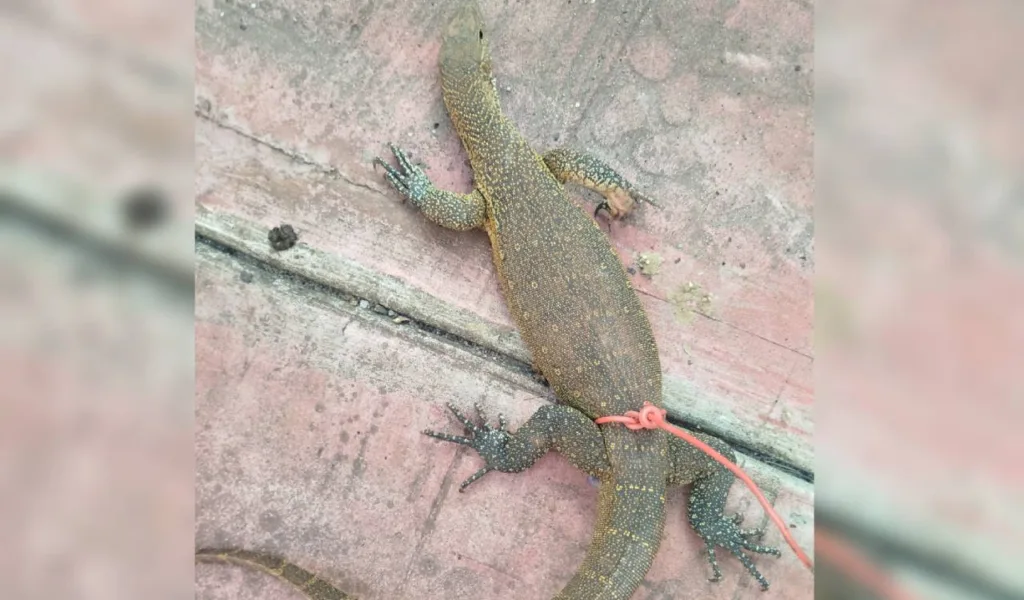
    Two trafficked monitor lizards were rescued in Sangareddy, Telangana, following a complaint by People for the Ethical Treatment of Animals India. People for the Ethical Treatment of Animals India stated that it assisted local authorities in rescuing the wild animals from illegal trafficking, with the operation also taking place in Sadashivpet. A POR was registered following the complaint. This action matters because monitor lizards receive protection under the Wildlife (Protection) Act, 1972, which prohibits the illegal capture, possession, and trade of protected wildlife species. The forest department launched an investigation to identify the persons involved in the trafficking network and determine the source and intended destination of the captured animals, with further legal proceedings expected under the law.

Guides on this

Get Animal Writes updates

News, important developments and practical guides — no spam.

Newsletter

Email me Animal Writes updates. I can unsubscribe at any time.