From letters to the Supreme Court to a year-round resource for animals. Read the story

Exotic pets in India: what the law says

A tortoise with a patterned shell walking over dry leaves on a forest floor.

In India, exotic animals of species listed under CITES are in Schedule IV of the Wild Life (Protection) Act, 1972. Owners must register them on the PARIVESH 2.0 portal and report births, transfers and deaths. Breeding some of these species needs a licence from the state’s Chief Wildlife Warden.

Which exotic pets the law covers

Since the 2022 amendment, Chapter VB of the Wild Life (Protection) Act regulates the possession and trade of exotic species listed in Appendices I, II and III of CITES, through Schedule IV. Import of species not listed under CITES falls under the Foreign Trade (Development and Regulation) Act, 1992, and the Customs Act, 1962 applies at ports.

Registering an exotic pet on PARIVESH 2.0

  • Section 49M makes declaration and registration of Schedule IV animals mandatory.
  • The Living Animal Specimen (Reporting and Registration) Rules, 2023 require registration on PARIVESH 2.0, with numbers, sex and an identifier for each animal.
  • Report a birth within 7 days and a transfer within 15 days. Deaths must also be reported.
  • Owners must have each animal checked by a veterinarian registered with the Veterinary Council of India at least once every six months.

Breeding, buying and selling

  • No one may breed Schedule IV species listed in CITES Appendix I without a licence from the Chief Wildlife Warden (sections 49N and 49-O; Breeders of Species Licence Rules, 2023).
  • Section 49H bars trade in scheduled species except as Chapter VB allows. Scheduled specimens can be imported or exported only through 12 designated ports, including Chennai, Delhi, Mumbai, Kolkata and Kochi.
  • Sellers may claim to hold valid permits, but buyers can rarely check this in real time.

Seizures and cruelty

  • Forest officers, customs, police and the coast guard can seize illegally held exotic animals (section 50). Seized animals become government property (section 49Q).
  • Cruelty to any animal, exotic or not, is an offence under the Prevention of Cruelty to Animals Act, 1960 and sections 291 and 325 of the Bharatiya Nyaya Sanhita, 2023. See how to report animal cruelty.

What the law does not cover yet

  • There are no health standards for exotic pets after import, and no rule that vets report suspected zoonotic disease in them.
  • Section 62A lets the Central Government regulate or ban invasive alien species, but it has never been used, and there is no official national list of invasive species.
  • There is no national policy for owners to surrender an exotic animal they can no longer keep.

How big the trade is

The Ministry of Environment, Forest and Climate Change’s 2020 Voluntary Disclosure Scheme found over 40,000 people in 30 states and union territories keeping exotic pets. The trade was valued at about USD 42.6 million in 2024, and is projected to reach USD 75.8 million by 2030. Reptiles and birds dominate, such as green iguanas, royal ball pythons, African grey parrots and blue-and-gold macaws.

Questions and answers

Questions about exotic pets in India

Animal welfare FAQ

Yes, for species listed under CITES, if the animal is registered on PARIVESH 2.0 under Schedule IV of the Wild Life (Protection) Act, 1972. Breeding some species needs a licence from the Chief Wildlife Warden.

Register it on the PARIVESH 2.0 portal under the Living Animal Specimen (Reporting and Registration) Rules, 2023, with the number of animals, their sex and an identifier.

Report a birth within 7 days and a transfer within 15 days on PARIVESH 2.0. Deaths must also be reported.

Yes. Owners of Schedule IV animals must have them checked by a veterinarian registered with the Veterinary Council of India at least once every six months.

Breeding Schedule IV species listed in CITES Appendix I needs a licence from the state’s Chief Wildlife Warden, under the Breeders of Species Licence Rules, 2023.

Forest officers, customs, police and the coast guard can seize illegally held exotic animals. Seized animals become government property.

Sources

By Animal Writes

More guides

  • Human elephant conflict rose sharply in Karnataka, study finds

    Research

    Human elephant conflict rose sharply in Karnataka, study finds

    A study in the Journal of Geomatics found 1,22,986 human–elephant conflict incidents recorded across eight Karnataka districts from 2019 to 2023. Researchers analysed geo-tagged data from the e-Parihara web portal of the Karnataka Forest Department covering the Southern Western Ghats region. Kodagu district recorded the highest cases and compensation. Cases rose from 8,184 in 2019 to 30,912 in 2023, while compensation increased from ₹53.7 million to ₹390.4 million, totalling ₹1,050.5 million over five years. Districts within the Western Ghats were distinguished from those outside such as Mandya and Ramanagara to understand geographical dynamics. The study categorised damage into six types including crop loss, property damage, and human injury or death. It identified 1,998 conflict-prone villages, classifying 26.1% as Very High and 35.4% as High hotspots, with 9.4% as New or Emerging Hotspots. The authors suggest the village-level hotspot database supports targeted habitat management and policy interventions aligned with the Ministry of Environment, Forest and Climate Change 2023 mitigation guidelines, emphasising early warning and rapid response systems.

  • Two light brown cows standing behind a barbed-wire fence on a field, trees and a house behind them under an evening sky.

    Guide

    Who regulates animal welfare in India

    Who decides what for animals in India: the ministry, AWBI, CCSEA and lab committees, state boards and district SPCAs, forest departments, police and courts.

From the Library

  • The Wild Life (Protection) Act, 1972

    Act

    The Wild Life (Protection) Act, 1972

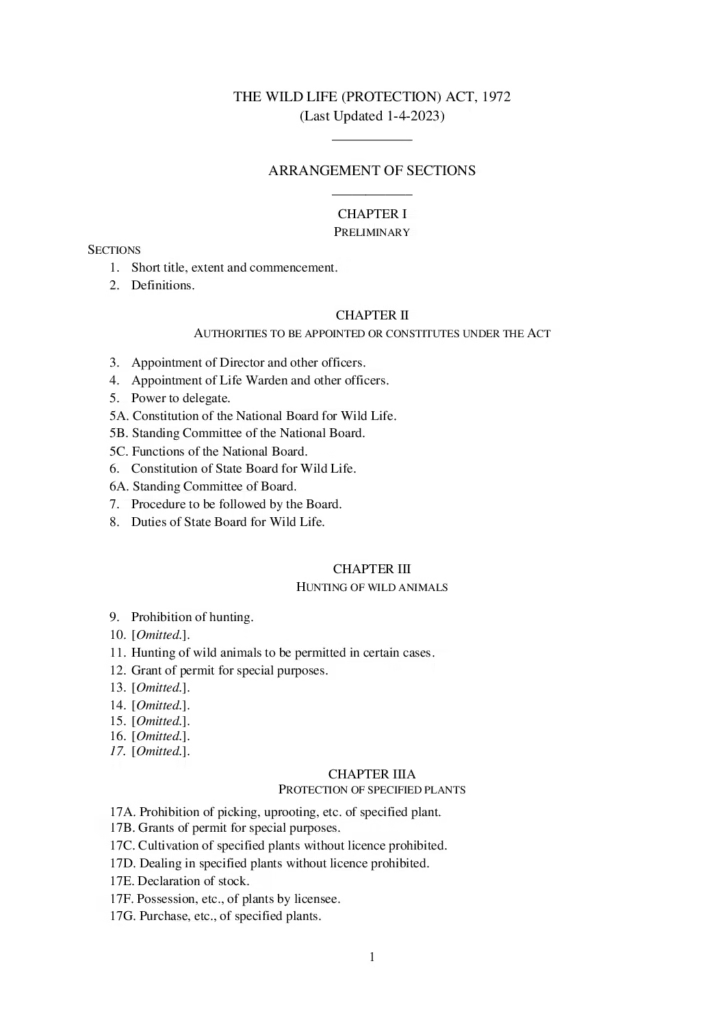
    The Wild Life (Protection) Act, 1972 (Act No. 53 of 1972, dated 9 Sep 1972) is India’s principal statute for conserving, protecting and managing wild animals and plants. It applies to the Union and State governments, wildlife authorities, hunters, traders, zoos, the Central Zoo Authority, the National Tiger Conservation Authority, the Wildlife Crime Control Bureau and any person dealing with wildlife. The Act bans hunting of species listed in its Schedules — the Schedules being the official lists of protected wildlife — and makes any wild animal taken in contravention of the law government property. Section 39 states, “wild animals taken contrary to the Act shall be property of the Government.” It also regulates trade in animal articles and trophies (Chapter V) and, since amendments up to 2022, extends to international trade under CITES and to invasive alien species (Section 62A). In practice, hunters must obtain a permit for any capture of a scheduled animal; traders need licences to deal in trophies or animal articles; zoos must be recognised by the Central Zoo Authority before acquiring animals; and any import, export or re‑export of scheduled specimens requires a licence issued by the designated management authority. For community animal feeders and the public, the Act means they must ensure that stray or community dogs they care for are not listed species and that no wildlife is moved or sold without the required permissions.

  • 45 live reptiles seized at Trichy airport, 2 arrested

    Official Release

    45 live reptiles seized at Trichy airport, 2 arrested

    The Directorate of Revenue Intelligence issued a seizure report detailing how officers foiled an attempt to smuggle live reptiles into India at Trichy Airport. The action applies to international passengers and wildlife smugglers operating through airports. According to Free Press Journal, officers intercepted two Indian passengers arriving from Bangkok via Colombo on 26 Oct 2026. A systematic examination of passenger baggage led to the recovery of forty-five live reptiles concealed inside twenty-seven food packets while the sedated animals remained hidden. The seized animals comprised twenty-three Corn Snakes, sixteen Ball Pythons, five Argentine Black and White Tegus, and one Snow White Iguana. Two passengers faced arrest by the Air Intelligence Unit, Trichy, under the provisions of the Customs Act, 1962, and the recovered wildlife went to the unit for further necessary action. In practice, this means travellers attempting to transport animals illegally face baggage searches, confiscation of concealed wildlife, and arrest under federal customs laws. Readers can report suspected wildlife trafficking activity to customs authorities and airport intelligence units.

  • NHAI document on wildlife crossings on highways

    Official Release

    NHAI document on wildlife crossings on highways

    The National Highways Authority of India issued a document titled “Wildlife Mitigation Measures & Structures.” The paper outlines new and reinforced measures intended to protect wildlife along the country’s national highways. It details specific structures and strategies for conserving animals in these areas, backed by an investment of over Rs. 19,700 crore and more than 2,150 wildlife mitigation structures.

Get Animal Writes updates

News, important developments and practical guides — no spam.

Newsletter

Email me Animal Writes updates. I can unsubscribe at any time.