
From letters to the Supreme Court to a year-round resource for animals. Read the story

Mapping monkey conflict to guide city planning in Shimla

Mapping monkey conflict to guide city planning in Shimla

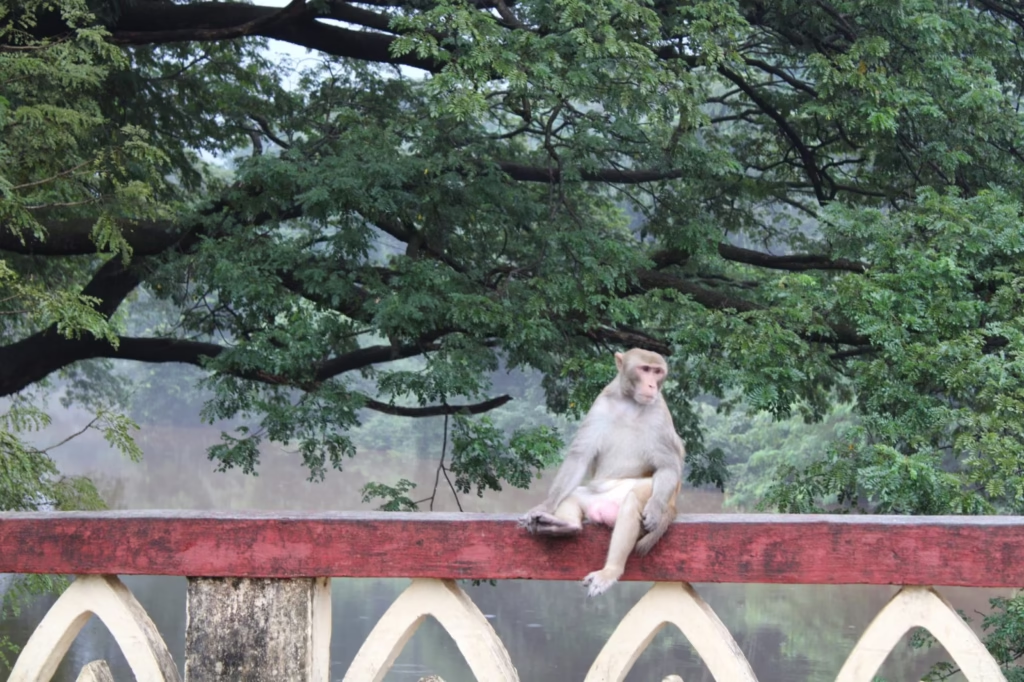
A new study found that spatial analysis of human‑Rhesus macaque conflict can guide wildlife‑sensitive smart‑city planning in Shimla. The researchers used geospatial intelligence and spatial statistical methods to examine the urban primate paradox, mapping where and how Rhesus macaques interact with people across the city. Their analysis revealed distinct spatial patterns of conflict that authorities could use to design urban interventions that accommodate wildlife populations. The authors suggest that applying such spatial analyses may improve planning decisions in urban areas where humans and wildlife coexist.

Questions about the monkey conflict study in Shimla

Animal welfare FAQ

Ajitesh Singh Chandel carried out the study, titled “Exploring the Urban Primate Paradox: geospatial intelligence and spatial statistical perspectives on human–Rhesus macaque conflict for wildlife-sensitive smart city planning in Shimla, India”. Read the study.

The study was published in Geology, Ecology, and Landscapes on . See it in the journal.

A new study found that spatial analysis of human‑Rhesus macaque conflict can guide wildlife‑sensitive smart‑city planning in Shimla. Read the full study.

Sources

Study: Exploring the Urban Primate Paradox: geospatial intelligence and spatial statistical perspectives on human–Rhesus macaque conflict for wildlife-sensitive smart city planning in Shimla, India by Ajitesh Singh Chandel in Geology, Ecology, and Landscapes Read the original (opens in a new tab)

Summary written by Animal Writes. Read the original before relying on it.

More research

  • Human elephant conflict rose sharply in Karnataka, study finds

    Research

    Human elephant conflict rose sharply in Karnataka, study finds

    A study in the Journal of Geomatics found 1,22,986 human–elephant conflict incidents recorded across eight Karnataka districts from 2019 to 2023. Researchers analysed geo-tagged data from the e-Parihara web portal of the Karnataka Forest Department covering the Southern Western Ghats region. Kodagu district recorded the highest cases and compensation. Cases rose from 8,184 in 2019 to 30,912 in 2023, while compensation increased from ₹53.7 million to ₹390.4 million, totalling ₹1,050.5 million over five years. Districts within the Western Ghats were distinguished from those outside such as Mandya and Ramanagara to understand geographical dynamics. The study categorised damage into six types including crop loss, property damage, and human injury or death. It identified 1,998 conflict-prone villages, classifying 26.1% as Very High and 35.4% as High hotspots, with 9.4% as New or Emerging Hotspots. The authors suggest the village-level hotspot database supports targeted habitat management and policy interventions aligned with the Ministry of Environment, Forest and Climate Change 2023 mitigation guidelines, emphasising early warning and rapid response systems.
  • Human Wildlife Conflict in Kerala: Spatial Patterns and Community Perceptions in Selected Forest Fringe Areas

    Research

    Human Wildlife Conflict in Kerala: Spatial Patterns and Community Perceptions in Selected Forest Fringe Areas

    A study found Wayanad district accounted for 17 of 42 recorded human deaths from human-wildlife conflict in Kerala between 2021 and 2025, with Asian elephants linked to 27 fatalities. Researchers from CHRIST (Deemed to be University) in Bengaluru mapped fatalities using newspaper archives and GIS tools and conducted structured interviews with 50 residents in Mulli, Sholayur and settlements near Chimmini Dam during the same period. The authors found avoidance of night-time outdoor movement (mean score 4.22) and worry for family safety (3.84) were common fear responses, while sleep disturbance scored 3.24. Educational impacts were limited among ten respondents with school-going children. Compensation awareness varied from 30.8% among those without formal schooling to 83.3% among graduates, and low awareness made up 42.1% of 76 cited insurance barriers. Forest Department incident response rated 4.38 versus 2.24 for government conflict-control measures. The researchers suggest regular upkeep of preventive infrastructure and clearer information on financial support schemes deserve attention.

  • Elephant attacks in Nagaon, Assam, peak at rice harvest

    Research

    Elephant attacks in Nagaon, Assam, peak at rice harvest

    Research on human-elephant conflict in Assam found that 23.35% of villages in Nagaon District reported incidents, with attacks peaking during the December rice harvest. A study published in Scientific Reports analyzed twenty-one years of compensation records from Nagaon District in Assam, India, covering the years 1999 through 2020. The authors evaluated the spatial, seasonal, and institutional structure of the conflict by applying Getis-Ord Gi and Local Moran's I statistics to 1,915 georeferenced incidents across 1,032 villages. The team also examined 1,788 records containing complete financial data using non-parametric correlation, Theil-Sen regression, and segmentation by policy regime. The study found that conflict occurred in 241 villages, yielding the 23.35% figure. Incidents concentrated along the Karbi Anglong foothills, and human casualty clusters were found in the northeastern part of the district. Attacks peaked in December at 23.29%, aligning with the Sali rice harvest. Property and crop damage formed over 88% of claims while receiving under 28% of disbursed funds, whereas human fatalities made up 6.26% of claims and took 68.37% of funds. Claim volume explained 31.8% of the payout variation, with rate revisions accounting for the rest. The authors suggest that mitigation should be spatially targeted and seasonally adaptive, and compensation should change into a tiered, need-opedic model recognizing chronic livelihood loss alongside catastrophic outcomes.

From the Library

  • 45 live reptiles seized at Trichy airport, 2 arrested

    Official Release

    45 live reptiles seized at Trichy airport, 2 arrested

    The Directorate of Revenue Intelligence issued a seizure report detailing how officers foiled an attempt to smuggle live reptiles into India at Trichy Airport. The action applies to international passengers and wildlife smugglers operating through airports. According to Free Press Journal, officers intercepted two Indian passengers arriving from Bangkok via Colombo on 26 Oct 2026. A systematic examination of passenger baggage led to the recovery of forty-five live reptiles concealed inside twenty-seven food packets while the sedated animals remained hidden. The seized animals comprised twenty-three Corn Snakes, sixteen Ball Pythons, five Argentine Black and White Tegus, and one Snow White Iguana. Two passengers faced arrest by the Air Intelligence Unit, Trichy, under the provisions of the Customs Act, 1962, and the recovered wildlife went to the unit for further necessary action. In practice, this means travellers attempting to transport animals illegally face baggage searches, confiscation of concealed wildlife, and arrest under federal customs laws. Readers can report suspected wildlife trafficking activity to customs authorities and airport intelligence units.

  • NHAI document on wildlife crossings on highways

    Official Release

    NHAI document on wildlife crossings on highways

    The National Highways Authority of India issued a document titled “Wildlife Mitigation Measures & Structures.” The paper outlines new and reinforced measures intended to protect wildlife along the country’s national highways. It details specific structures and strategies for conserving animals in these areas, backed by an investment of over Rs. 19,700 crore and more than 2,150 wildlife mitigation structures.

  • 86 live tokay geckos seized in Assam, two arrested

    Official Release

    86 live tokay geckos seized in Assam, two arrested

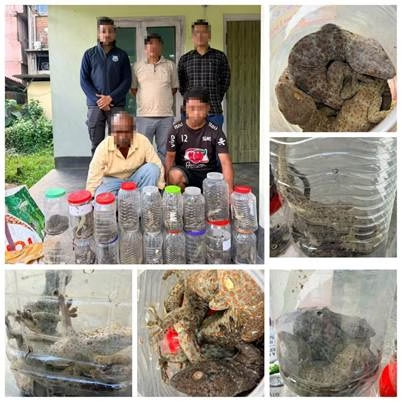
    The Directorate of Revenue Intelligence confiscated 86 live Tokay geckos in Assam during a wildlife trafficking crackdown. Acting on specific intelligence regarding an illegal trade deal, officers intercepted two individuals at Bandar Chalia Gaon Ground in Mariani. The endangered animals were seized under the provisions of the Wildlife (Protection) Act, 1972, and the two apprehended persons were subsequently handed over to the Mariani Range Forest office for further action.

Get Animal Writes updates

News, important developments and practical guides — no spam.

Newsletter

Email me Animal Writes updates. I can unsubscribe at any time.