If a dog, cat or any other animal has bitten or scratched you, get treatment today. Wash the wound with soap under running water for 15 minutes, then go to a government hospital or health centre the same day to start the rabies injection. The course takes 4 or 5 visits over 28 days and is free at government facilities. Start even if the bite was days ago, and even if the animal looks healthy. Once rabies symptoms appear, it is virtually 100% fatal (WHO); before then, the vaccine prevents it. This page is general information, not a substitute for a doctor.
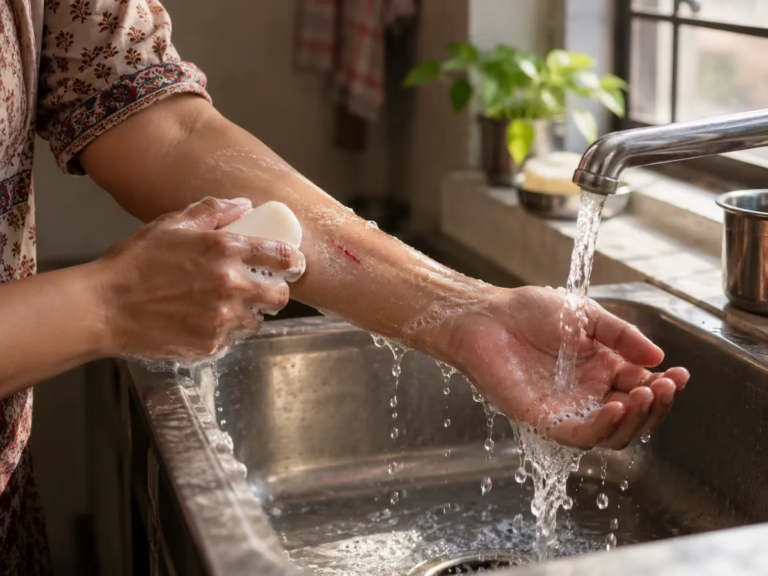
Wash the wound for 15 minutes, then go the same day
- Wash every bite and scratch under running tap water with soap for 15 minutes, as soon as you can.
- After washing, apply an antiseptic such as povidone iodine or alcohol.
- Do not touch the wound with bare hands, and do not put chillies, oil, lime, herbs, chalk, soil or betel leaves on it.
- Go to a doctor or the nearest government health facility the same day.
Wash it even if you are late: India’s guideline says wound care must be done whenever the person comes in. Full first aid, step by step: what to do after a dog bite in India.
In India every animal bite is treated as possible rabies
- You cannot tell a rabid animal by looking, so India’s guideline treats every animal bite as a possible rabies exposure.
- A vaccinated dog is no guarantee. Start the injection anyway.
- Do not wait 10 days to watch the animal. Start at once. The 10-day watch applies to dogs and cats only: if the dog or cat is still healthy after 10 days, the doctor may shorten the course given into the muscle. The course given into the skin is always finished.
- Bites by wild animals, and all bites in forest areas, count as the most serious category (III).
The rabies injection takes 4 or 5 visits over 28 days
India’s national guideline (NCDC 2019) uses two schedules. Day 0 is the day of your first dose, not the day of the bite.
| Route | Dose | Days | Visits |
|---|---|---|---|
| Into the skin (intradermal) | 0.1 ml at each of two sites | 0, 3, 7, 28 | 4 |
| Into the muscle (intramuscular) | one dose in the upper arm (thigh for small children, never the buttock) | 0, 3, 7, 14, 28 | 5 |
- Finish the doses on days 0, 3 and 7 within 10 days. Being a day or two late does not mean starting again; tell the doctor.
- If you can show you completed a full course before, you need two doses, on days 0 and 3, and no immunoglobulin.
- For a category III exposure, rabies immunoglobulin (RIG) is also given once, into and around the wound, with the first dose or soon after, and not after day 7. More: how rabies immunoglobulin is dosed into the wound.
- India did not adopt the shorter schedules some foreign pages describe. Follow the dates your clinic gives you and keep your vaccination card.
The kind of contact decides the injections
The doctor decides your category. In short (NCDC 2019):
| Category | What happened | What you get |
|---|---|---|
| I | Touching or feeding the animal; a lick on unbroken skin | Washing. No vaccine when there is a reliable account of what happened |
| II | A nibble on bare skin; a minor scratch or graze without bleeding | Washing and the vaccine |
| III | A bite or scratch through the skin; a lick on broken skin; saliva in the eyes, mouth or nose | Washing, rabies immunoglobulin and the vaccine |
- People with weakened immunity get immunoglobulin for category II too.
- Bats: India’s guideline says bat exposure does not currently need rabies treatment here, because bat rabies has not been proven in India. See a doctor after any bat contact all the same.
- The full table: dog bite categories I, II and III.
The injections are free at government hospitals
- The rabies vaccine and rabies immunoglobulin are free at public health facilities under the National Health Mission’s National Free Drug Initiative.
- Stock varies: an ICMR study found the vaccine at about 80% of public facilities. If a centre has none, ask to be sent to the nearest anti-rabies clinic. Do not skip the vaccine because immunoglobulin is out; start the vaccine the same day.
- The Supreme Court’s order of requires all hospitals to stock the vaccine and immunoglobulin.
- At private hospitals and clinics, a vaccine dose usually costs a few hundred rupees and up, and immunoglobulin several thousand rupees. Prices vary; ask before treatment.
Symptoms come weeks or months later, when it is too late to treat
- Rabies symptoms typically start 2 to 3 months after a bite, but this may vary from one week to one year (WHO).
- The first signs are fever and pain or an unusual tingling or burning at the bite. More on the early signs of rabies in humans.
- Never wait for a sign. Once symptoms start, there is no reliable cure.
- Bitten weeks or months ago and never treated? Go today. India’s guideline says people who come months or even years later should be treated as if the bite were recent.
India’s rabies programme works to end dog-bite deaths
- An ICMR-National Institute of Epidemiology survey (2022–23, published 2024) estimated about 5,726 rabies deaths and 9.1 million animal bites a year in India. Hospitals report only a few hundred deaths a year, because most are never reported.
- India’s National Rabies Control Programme, run by the National Centre for Disease Control, pays for training, surveillance, laboratories and awareness. The medicines themselves come through the National Health Mission.
- Several states have made human rabies a notifiable disease, Delhi most recently in early 2026, so every case must be reported.
This guide is general information, not medical advice. After any bite or scratch, see a doctor the same day.
 By Animal Writes