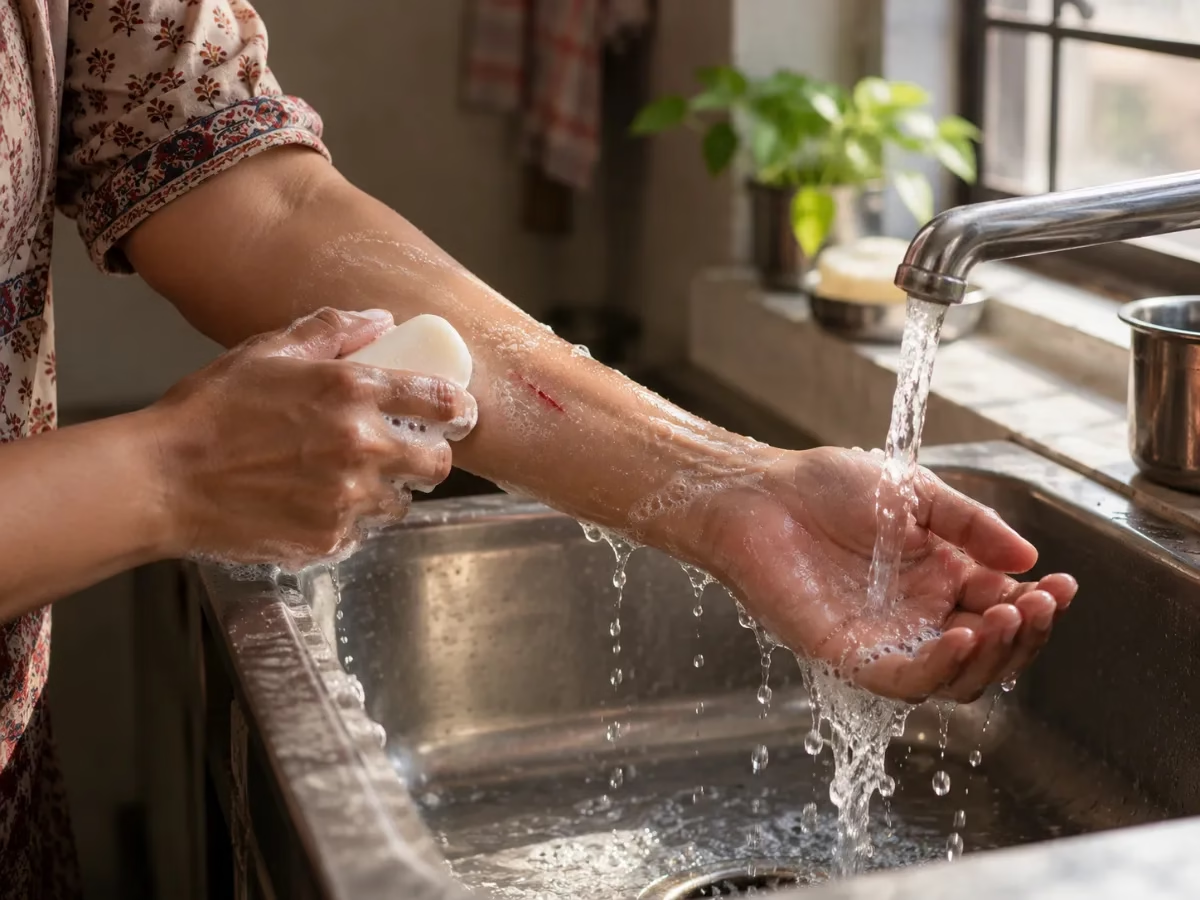
After a dog bite in India: wash the wound with soap under running water for 15 minutes, then go to a government hospital or health centre the same day. The rabies vaccine is given on days 0, 3, 7 and 28 (into the skin) or days 0, 3, 7, 14 and 28 (into the muscle). Deep or bleeding bites (category III) also need rabies immunoglobulin, injected into the wound. Both are free at government health facilities. This is general information; the doctor decides your category and your schedule.
Who to call
| For | Number | Notes |
|---|---|---|
| Rabies advice after a bite (the person) | 15400 | National Rabies Helpline (NCDC). Free. 16 hours a day, 7 days. Covers Delhi, Assam, Andhra Pradesh, Madhya Pradesh and Puducherry for now. Also answers snakebite questions. |
| Heavy bleeding or a severe bite (the person) | 112 or 108 | 112 is the national emergency number; 108 is the free ambulance in many states. |
| The dog that bit, if it is hurt or ill | 1962 | State animal helpline and mobile veterinary units. For the animal, not the person. |
What should I do straight after a dog bite?
- Wash all wounds and scratches under running tap water with soap for 15 minutes. Do it as soon as you can.
- After washing and drying, apply an antiseptic such as povidone iodine or alcohol.
- Do not touch the wound with bare hands.
- Do not put chillies, oil, turmeric, lime, salt, ash, chalk, herbs or betel leaves on the wound. If something was put on it, wash it off gently with soap and plenty of water.
- Never burn the wound or put acid on it.
- Do not cover the wound with a dressing, and do not get it stitched straight away. Leave that to the doctor.
- Go to a doctor or the nearest government health facility immediately.
If there is no soap, wash the wound well with plenty of water. If saliva got into the eyes or mouth, rinse them well with water. Wash the wound even if you are late: the guideline says wound care must be done whenever the person reports.
Does every dog bite need treatment?
In India, every animal bite is treated as a possible rabies exposure, and treatment should start straight away. The national guideline also says:
- A bite from a vaccinated dog still needs treatment, because the dog’s protection cannot be assumed.
- A provoked bite still needs treatment. Provocation does not mean the dog is free of rabies.
- Pregnancy, breastfeeding, infancy, old age and other illness are not reasons to skip treatment.
- People who come months or years after a possible exposure should be assessed and treated as if it happened recently.
What are dog bite categories I, II and III?
The doctor decides the category. This is the table from India’s national guideline (NCDC 2019), which follows the WHO’s three categories.
| Category | What counts | What to do |
|---|---|---|
| I | Touching or feeding an animal; a lick on unbroken skin; unbroken skin touched by the saliva of a rabid animal or person | Wash for 15 minutes and apply antiseptic. No vaccine when there is a reliable account of what happened. |
| II | Nibbling of uncovered skin; minor scratches or grazes without bleeding | Wash for 15 minutes, antiseptic, and the rabies vaccine. |
| III | One or more bites or scratches that go through the skin; a lick on broken skin; saliva in the eyes, mouth or nose | Wash for 15 minutes, antiseptic, rabies immunoglobulin (RIG) and the rabies vaccine. |
- A wound that bleeds counts as a severe (category III) exposure.
- Bites by wild animals, and all bites in forest areas, count as category III.
- People with weakened immunity (HIV, cancer treatment, long-term steroids) get immunoglobulin for category II too.
How many dog bite injections do I need?
The rabies vaccine (anti-rabies vaccine, ARV) is given as a course. Day 0 is the day of the first dose, not the day of the bite. India’s national guideline gives two schedules; the National Rabies Control Programme prefers the first.
| Situation | Route | Days | Visits |
|---|---|---|---|
| After a bite, first course (preferred in India) | Into the skin (intradermal), 0.1 ml at two sites, one on each upper arm | 0, 3, 7, 28 | 4 |
| After a bite, first course | Into the muscle (intramuscular), one dose in the upper arm (outer thigh for small children, never the buttock) | 0, 3, 7, 14, 28 | 5 |
| Before any bite (vets, dog handlers, rescuers) | Into the skin, one site, or into the muscle | 0, 7, and 21 or 28 | 3 |
| Bitten again, with proof of a full earlier course | Into the skin (one site) or into the muscle | 0, 3 | 2, and no immunoglobulin |
| Bitten again, full course finished within the last 3 months (proof needed) | – | Wound washing only | 0 |
| No proof of an earlier course, or the old nerve-tissue vaccine | As a new case | 0, 3, 7, 28 or 0, 3, 7, 14, 28 | 4 or 5 |
The three injections people ask about by name are the rabies vaccine (ARV), rabies immunoglobulin (RIG, also called anti-rabies serum, ARS) and the tetanus injection (TT or Td). They are separate injections.
Rules during the course
- Keep to the dates. The doses on days 0, 3 and 7 should be finished within 10 days. Being a day or two late does not mean starting again, but tell the doctor.
- People with weakened immunity, or who take chloroquine, hydroxychloroquine, long-term steroids or other drugs that suppress immunity, get the vaccine into the muscle.
- Changing the route or the vaccine brand mid-course is not routine. If it has to happen, the course is continued, not restarted.
- Stay at the clinic for 15 to 20 minutes after each dose. Do not rub the injection site or put anything on it.
- Finishing matters: in Khandwa, Madhya Pradesh, only 44.8% of bite victims finished the course. Modern rabies vaccines used in India are safe and effective.
Do I need a tetanus injection after a dog bite?
- The national rabies guideline says tetanus protection is given “as per national guidelines”, and the doctor may also prescribe antibiotics.
- India now uses the Td injection (tetanus and adult diphtheria) in place of TT for all ages; older TT stock is used up first.
- The doctor decides whether you need it from when you last had a tetanus injection and how deep or dirty the wound is. Bring your vaccination card if you have one.
- The tetanus injection does not replace the rabies vaccine. They are separate injections.
Rabies immunoglobulin (RIG) and monoclonal antibodies
Rabies immunoglobulin gives ready-made antibodies while the body builds its own after the vaccine.
- It is needed for every category III exposure, and for category II in people with weakened immunity.
- As much of it as possible is injected into and around the wound, once, with the first vaccine dose or as soon as possible after. It is not given after day 7 of the course. An infected wound is not a reason to skip it. If stitches cannot be avoided, RIG goes in first and the stitching waits a few hours.
- There are two types: equine (ERIG, from horses) and human (HRIG). A skin test is not required for ERIG under the national guideline.
- People who can show they completed an earlier course do not need it.
- If RIG is out of stock, the vaccine must still start the same day; ask for the nearest facility that has RIG. Shortages are real: in 2025, 126 government hospitals had no anti-rabies vaccine and 375 had no RIG. Wound dosing makes limited RIG go further.
Monoclonal antibodies. Two monoclonal antibody products are sold in India as alternatives to RIG: Rabishield (a single antibody, Serum Institute of India) and Twinrab (a two-antibody cocktail, Zydus). An Indian study found both the single and the cocktail products safe. The national guideline (2019) notes that WHO recommends them, but says their role must be studied in India before they are added to the guideline; they are not yet in it. Ask your doctor which product you are being given.
I have had the rabies vaccine before. What do I need?
- If you can show you completed an earlier course (after a bite, or before one), you need wound care and two doses on days 0 and 3. No immunoglobulin is needed.
- If that course was completed within the last three months, wound washing alone is enough.
- If you cannot show proof, or had the old nerve tissue vaccine, you get the full course as a new case.
Keep your vaccination card safe. It is your proof.
Is the rabies vaccine free, and where do I go?
Yes, in public health facilities. Under the National Rabies Control Programme, the anti-rabies vaccine and anti-rabies serum (immunoglobulin) are free in government hospitals, community health centres and primary health centres under the National Free Drug Initiative. Many district hospitals run an anti-rabies clinic. If a facility has none in stock, ask where the nearest stocked facility is, or call 15400 in the five states it covers. Private hospitals and clinics charge. The Directory lists animal welfare organisations, not human clinics.
The 10-day rule: watching the dog
Start treatment straight away; never wait to see whether the dog falls ill. The 10-day observation applies to dogs and cats only. If the dog or cat that bit you is still healthy after 10 days, the doctor may cut the intramuscular course short by skipping the day 14 dose and giving the day 28 dose. The intradermal course is always completed. This medical rule is separate from what the law does with the dog, below.
Where do I report a dog bite?
- At the health facility: tell the doctor where and when the bite happened. Dog bites and rabies deaths are reported monthly through the Integrated Disease Surveillance Programme portal.
- To your local body: under the Animal Birth Control Rules, 2023, the local authority may set up an animal helpline. Dog bite complaints are recorded in a register, and the information is shared with the government hospital so it can recommend treatment.
- If the dog may have rabies: the rules ask the local authority to set up an Animal Complaint Cell at the Animal Birth Control centre for bites by dogs suspected of rabies.
Give the date, time and place, and a description of the dog. This helps the right dog to be found and observed. If the dog itself is hurt or ill, see the 1962 helpline and mobile veterinary units.
What happens to the dog that bit?
Under the Animal Birth Control Rules, 2023:
- The dog is caught humanely by a trained team and kept for observation at the Animal Birth Control centre.
- A dog showing signs of a communicable disease is kept in an isolation kennel and given food and water twice a day.
- A suspected rabid dog is examined by a vet appointed by the local authority and a representative of an animal welfare organisation.
- If rabies is highly likely, the dog is isolated until it dies a natural death. The rules note this normally happens within ten days.
- If the dog does not have rabies but has another illness or is aggressive, it is handed to an animal welfare organisation to be treated and released after ten days of observation.
In its judgment of (2026 INSC 506), the Supreme Court allowed authorities to take legally permitted measures against rabid, incurably ill or demonstrably dangerous dogs, only after assessment by qualified veterinary experts. See the Supreme Court stray dog orders explained.
Do not hurt or chase the dog. Report it, so a trained team can deal with it. If the dog is injured, see what to do first for an injured animal. If someone harms a dog, see how to report animal cruelty. Local animal welfare groups can help with community dogs: find one in the Directory.
Rabies in India: ten questions people are searching
India has about 5,726 human rabies deaths a year, the ICMR-National Institute of Epidemiology estimated in 2025. Nearly all come from dog bites, and almost all are preventable with washing and the vaccine. More in Rabies facts from the WHO and World Rabies Day.
Do all dogs have rabies? No. Rabies is an infection, not something all dogs carry. A dog gets it from the bite of a rabid animal. But a rabid dog cannot be told apart by looking, so in India every dog bite is treated as a possible exposure.
Does every dog bite cause rabies? No. Only a bite or scratch from an infected animal can pass on the virus, and not every such bite does. Because there is no way to be sure on the day, treatment starts for every bite that breaks the skin.
What are the symptoms of rabies in humans? Early on: fever, pain, and unusual tingling, prickling or burning at the bite site. Later: anxiety, confusion, hyperactivity, fear of water or draughts, hallucinations, and in the paralytic form weakness that starts at the wound and spreads. (WHO)
What are the early signs of rabies? Fever, headache and a strange tingling or itching at the healed bite site are the usual first signs. By then it is too late to treat, which is why the vaccine must start before any sign appears.
Rabies symptoms appear in how many days? Usually 2 to 3 months after the bite, but anywhere from one week to one year, depending on where the bite is and how much virus entered. (WHO)
Can a cat scratch cause rabies? Yes, if the cat is rabid. Cats get and pass on rabies. A scratch that breaks the skin is treated as category II or III, with the same washing and vaccine as a dog bite.
Does a cat bite cause rabies? It can. A cat bite is treated exactly like a dog bite: wash for 15 minutes, see a doctor the same day, vaccine, and immunoglobulin for category III.
Does a rat bite cause rabies? Rabies from rats is extremely rare; WHO says bites from rodents are not known to transmit rabies. Still wash the wound and see a doctor the same day, for tetanus and infection. The doctor decides whether rabies treatment is needed.
Is rabies curable? Once symptoms appear, rabies is almost always fatal; only a handful of survivors are known worldwide. It is almost 100% preventable if washing and the vaccine start before symptoms.
What are the side effects of the rabies injection? Usually mild and short: pain, redness or swelling where it was given, sometimes a mild fever, headache or tiredness. Serious reactions are rare with the modern vaccines used in India. Tell the doctor about any reaction; never stop the course on your own.
I only got a scratch and there is no blood. Do I need the vaccine?
Yes. A minor scratch or graze without bleeding, or a nibble on uncovered skin, is a Category II exposure. It needs wound washing and the rabies vaccine. Only touching or feeding an animal, or a lick on unbroken skin, is Category I, which needs washing but no vaccine when there is a reliable history. A bite or scratch that breaks the skin, or that bleeds, is Category III and also needs rabies immunoglobulin. The doctor decides the category.
Is it too late to get the vaccine?
No. Start as soon as you can, but do not skip treatment because time has passed. The national guideline says people who come months or even years after a possible exposure should be assessed and treated as if it happened recently. Wash the wound too, whenever you report.
What if I miss a dose?
Go for the missed dose as soon as you can and tell the doctor. Being a day or two late does not mean starting the course again. Try to finish the doses on days 0, 3 and 7 within 10 days, and keep your vaccination card with the dates.
हिंदी में: कुत्ते के काटने पर क्या करें
- घाव को साबुन और बहते पानी से 15 मिनट तक धोएँ। फिर कोई एंटीसेप्टिक लगाएँ।
- घाव पर मिर्च, तेल, हल्दी, चूना, नमक या राख न लगाएँ। उस पर पट्टी न बाँधें और तुरंत टाँके न लगवाएँ।
- उसी दिन डॉक्टर के पास या नज़दीकी सरकारी अस्पताल जाएँ। सरकारी अस्पतालों और स्वास्थ्य केंद्रों में रेबीज़ का टीका और इम्युनोग्लोबुलिन (सीरम) मुफ़्त है।
- टीका त्वचा में (इंट्राडर्मल) दिन 0, 3, 7 और 28 को, यानी चार बार, या मांसपेशी में (इंट्रामस्कुलर) दिन 0, 3, 7, 14 और 28 को, यानी पाँच बार लगता है। पूरा कोर्स करें।
- बिना ख़ून वाली हल्की खरोंच पर भी टीका ज़रूरी है। गहरे या ख़ून निकलने वाले घाव पर इम्युनोग्लोबुलिन भी लगता है।
- कुत्ते को टीका लगा हो, तब भी इलाज ज़रूरी है। देर हो गई हो, तब भी इलाज शुरू करें।
- काटने की तीन श्रेणियाँ हैं: श्रेणी I (छूना, बिना घाव की त्वचा चाटना): धोना काफ़ी; श्रेणी II (बिना ख़ून की खरोंच): टीका; श्रेणी III (गहरा या ख़ून वाला घाव): टीका और इम्युनोग्लोबुलिन। श्रेणी डॉक्टर तय करते हैं।
- डॉक्टर टिटनेस का इंजेक्शन (Td) भी लगा सकते हैं। यह रेबीज़ के टीके की जगह नहीं लेता।
Questions and answers
This guide is general information, not medical advice. See a doctor straight away after any bite or scratch.
 By Animal Writes