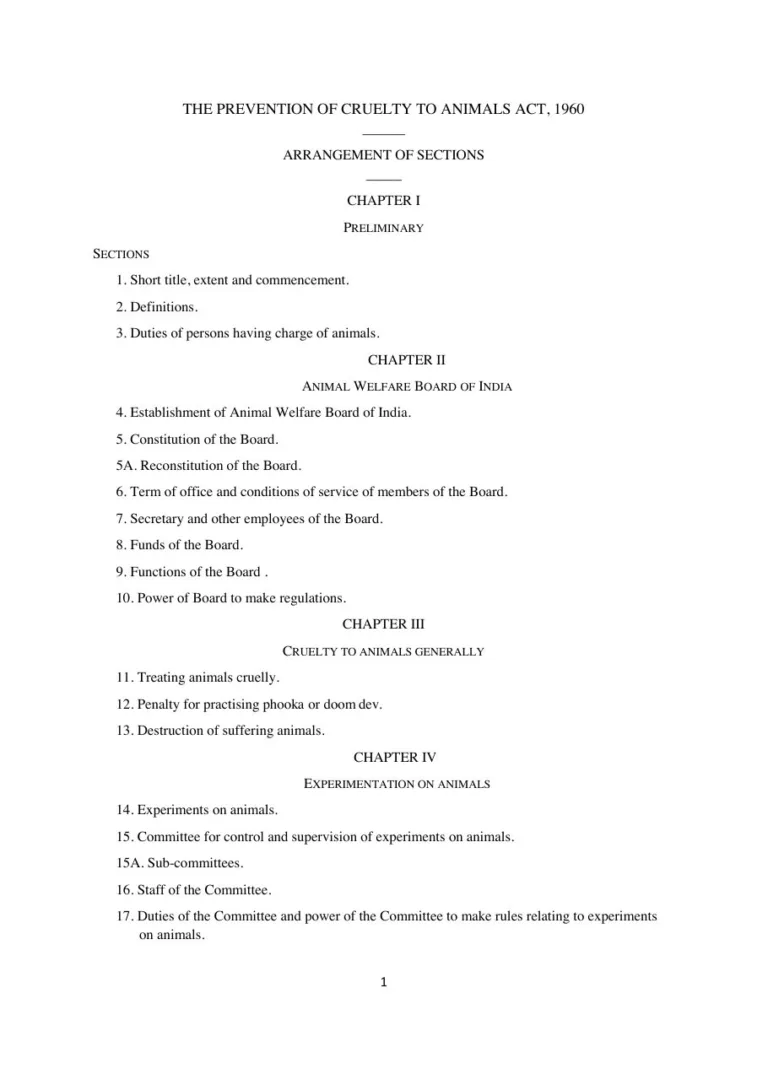
Two laws do most of the work. Section 11 of the Prevention of Cruelty to Animals Act, 1960 (PCA Act) lists acts of cruelty, with a fine of Rs 10 to Rs 50 for a first offence. Section 325 of the Bharatiya Nyaya Sanhita, 2023 (BNS) punishes killing, poisoning, maiming or rendering useless any animal with up to five years in prison, a fine, or both. In a serious case the police usually register both. The fines have not gone up: the 2022 bill to raise them has never been introduced in Parliament.
To report a case now, see How to report animal cruelty and file an FIR.
Section 11 of the PCA Act lists fifteen kinds of cruelty
Under section 11(1), a person commits an offence if they do any of the following, or, as the owner, allow it. In short:
| Clause | The act |
|---|---|
| 11(1)(a) | Beating, kicking, over-riding, over-driving, over-loading or torturing an animal, or treating it so that it suffers unnecessary pain |
| (b) | Working an animal that is unfit because of age, disease, injury or a sore |
| (c) | Wilfully and unreasonably giving an animal an injurious drug or substance |
| (d) | Carrying an animal, in a vehicle or otherwise, in a way that causes it unnecessary pain |
| (e) | Keeping an animal in a cage or container too small for it to move reasonably |
| (f) | Keeping an animal chained or tethered for an unreasonable time, on an unreasonably short or heavy chain or cord |
| (g) | As the owner, not exercising a dog that is habitually chained or closely confined |
| (h) | As the owner, not giving an animal enough food, water or shelter |
| (i) | Abandoning an animal without reasonable cause where it is likely to suffer from hunger or thirst |
| (j) | As the owner, letting a contagiously diseased animal loose in a street, or letting a diseased or disabled animal die in a street |
| (k) | Offering for sale, or keeping without reasonable cause, an animal suffering from mutilation, starvation, thirst, overcrowding or other ill-treatment |
| (l) | Mutilating or killing any animal, stray dogs included, by strychnine injection in the heart or in any other unnecessarily cruel way |
| (m) | For entertainment only, confining an animal so that it becomes prey for another, or making animals fight or bait each other |
| (n) | Organising or running a place for animal fights or baiting, letting a place be used for it, or taking money for entry |
| (o) | Promoting or taking part in a shooting match where animals are released from captivity to be shot |
The penalty under section 11 is still Rs 10 to Rs 50
- First offence: a fine of at least Rs 10 and up to Rs 50.
- Second or later offence within three years of the last one: a fine of Rs 25 to Rs 100, or up to three months in prison, or both. The higher penalty applies only within that three-year window.
- Owners (section 11(2)): an owner is treated as having committed the offence if they did not take reasonable care to prevent it. An owner convicted only on that ground cannot be sent to prison without the option of a fine.
Section 11 does not apply in five cases
Section 11(3) leaves these outside the section:
- (a) dehorning, castration, branding or nose-roping, done in the prescribed way;
- (b) destroying stray dogs in lethal chambers or by other prescribed methods;
- (c) destroying any animal under the authority of a law;
- (d) experiments on animals, which Chapter IV of the Act covers;
- (e) killing an animal for food, unless it causes unnecessary pain or suffering.
On stray dogs today, the Supreme Court’s judgment of allows authorities, in areas where dog bites have become frequent, to euthanise rabid, incurably ill or demonstrably dangerous or aggressive dogs, after assessment by qualified vets and in line with the PCA Act and the Animal Birth Control Rules (para 108(H)). See the Supreme Court judgment of .
Phooka and doom dev carry up to two years in prison (section 12)
Section 12 punishes phooka or doom dev on a cow or other milch animal, and any other operation to make it give more milk that harms its health, or allowing it. The penalty is a fine of up to Rs 1,000, or up to two years in prison, or both. The animal is forfeited to the government.
Only four PCA offences are cognizable (section 31)
A cognizable offence is one the police can register and investigate without a magistrate’s order. Under section 31, that covers only:
- killing or mutilating an animal in an unnecessarily cruel way (11(1)(l));
- running a place for animal fights or baiting (11(1)(n));
- shooting matches with released animals (11(1)(o));
- phooka or doom dev (section 12).
Every other part of section 11 is non-cognizable: the police record the complaint and send you to the magistrate. On the Madras High Court held exactly this for section 11(1)(a) (Balaji v. State; see our Library copy). This is why, when an animal is killed, poisoned or maimed, the police register the case under BNS section 325, which is cognizable, together with section 11.
BNS section 325 punishes killing or maiming any animal with up to five years
- What it covers: mischief by killing, poisoning, maiming or rendering useless any animal.
- Penalty: prison of either description for up to five years, or a fine, or both.
- Any animal, any value: “animal” means any living creature other than a human being (BNS section 2(2)). The penalty no longer depends on the animal’s value, as it did under the old law.
- What it replaced: sections 428 and 429 of the Indian Penal Code, from .
- Cognizable.
- The police may enquire first: because it carries up to five years, the police may hold a preliminary enquiry of up to 14 days before registering the FIR (BNSS section 173(3)).
Every person in charge of an animal has a duty of care (section 3)
Section 3 says anyone who has the care or charge of an animal must take all reasonable measures to ensure its well-being and to prevent unnecessary pain or suffering. Rules made under section 38 (on transport, loads, animal birth control and more) carry their own penalty: a fine of up to Rs 100, or up to three months in prison, or both.
The 2022 bill to raise the penalties is still a draft
The government published a draft Prevention of Cruelty to Animals (Amendment) Bill on for public comment. It proposed a new offence of “gruesome cruelty”, with a fine of Rs 50,000 to Rs 75,000 and/or one to three years in prison, and up to five years for killing an animal. In a written reply to Parliament on , the ministry said the bill was “under examination”. It has not been introduced, so none of these penalties is law. The fines above still apply. A separate private member’s bill to raise the penalties was introduced in the Rajya Sabha on ; it has not been passed.
The Supreme Court reads the five freedoms into the Act
In Animal Welfare Board of India v. A. Nagaraja (), the Supreme Court read the “five freedoms” of animals into sections 3 and 11, relying on Article 51A(g) of the Constitution, the duty to have compassion for living creatures, and on Article 21. It also banned jallikattu and bullock-cart races. On a five-judge Constitution Bench upheld the state laws that now allow jallikattu. So Nagaraja’s reasoning on the five freedoms still stands, but its jallikattu ban does not.
Wild animals have their own law
Hunting, capturing or trading wild animals and native birds is dealt with under the Wildlife (Protection) Act, 1972, not only the PCA Act. Report it to the state forest department. More in Animal welfare laws in India, in plain words.
How to act on a cruelty case
- Police: report at any police station, wherever it happened, or give the information electronically and sign it within three days (BNSS section 173(1)).
- If the police refuse: send the substance in writing, by post, to the Superintendent of Police (section 173(4)); then apply to the magistrate with an affidavit (section 175(3)).
- AWBI and the district SPCA: complain online to the Animal Welfare Board of India, and to your district SPCA, chaired by the District Collector.
- Step by step, with state details: How to report animal cruelty and file an FIR.
- Feeding community dogs is a separate question: feeding stray dogs and the law.
This guide is general information, not legal advice. Laws and court orders change; check the Library and the original documents. Last checked: .
 By Animal Writes