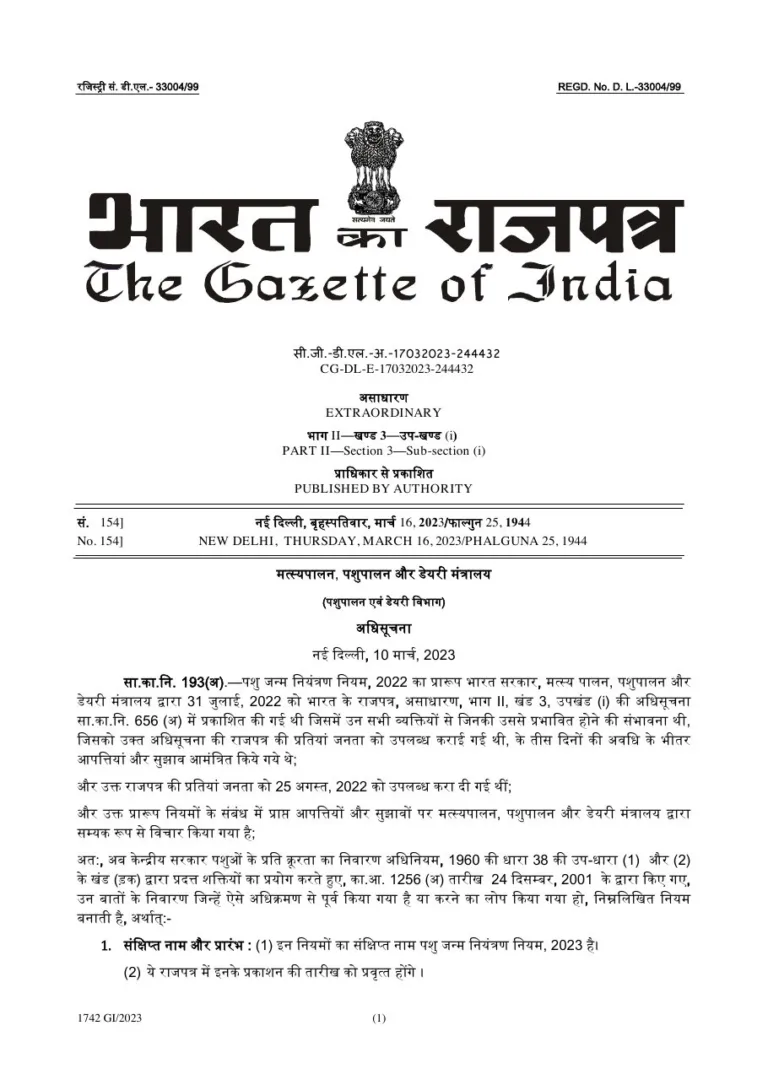
Feeding stray dogs on the street is not allowed anywhere in India. The Supreme Court banned it on and, in its judgment of , ordered strict compliance with that order. You may feed community dogs only at a designated feeding spot: one your municipal body creates in each ward, or, in a housing society, one agreed with your residents’ welfare association (RWA) under rule 20 of the Animal Birth Control Rules, 2023.
The Supreme Court did not stop feeding: it ordered feeding spaces in every ward. What the law now controls is where you feed. Follow the case in our Supreme Court stray dogs tracker.
The Supreme Court banned feeding on the streets on 22 Aug 2025
In the suo motu case In Re: “City Hounded by Strays, Kids Pay Price” (Suo Motu Writ Petition (Civil) 5 of 2025), a three-judge bench said in para 33(d) of its order of : “Under no condition shall the feeding of stray dogs on the streets be permitted.”
- Ward feeding spaces: municipal bodies must create dedicated feeding spaces in each municipal ward, based on the number of dogs there, with notice boards saying dogs may be fed only there (para 33(d)).
- Action against street feeding: people found feeding on the streets “shall be liable to be proceeded against under the relevant legal framework” (para 33(d)). The order does not name which law.
- A helpline: each municipal body must run a helpline to report violations (para 33(e)).
- No obstruction: anyone who obstructs officials carrying out the order can be prosecuted (para 33(f)).
- All of India: the same order widened the case beyond Delhi and the NCR to every State and Union Territory (paras 34–36).
The order of is often reported as a feeding ban. It is not: it removed stray dogs from schools, hospitals, sports complexes, bus stands and railway stations to shelters, and said they are not to be released back there (para 25(E)). Read the orders: , , .
The judgment of 19 May 2026 kept the ban in force
- The court dismissed every application to change its earlier orders, and upheld the Animal Welfare Board of India’s standard operating procedures (SOPs) of , which include feeding protocols and also cover parks, religious places and tourist sites (paras 76–85).
- All authorities must ensure “strict and faithful compliance” with the orders of and (para 109).
- Every High Court now runs its own case to monitor compliance, and may tailor the directions to local conditions without diluting them (para 111). States must report whether they have created feeding spaces in each ward (Annexure, item 26).
- Read it: Supreme Court judgment of (2026 INSC 506).
Where you may feed, and where you may not
| Place | Can you feed there? | Source |
|---|---|---|
| A designated feeding spot in your ward | Yes | SC order, , para 33(d) |
| A spot in your housing society agreed with the RWA | Yes | ABC Rules 2023, rule 20(1) |
| A street, road or other public place | No | SC order, , para 33(d) |
| Schools, hospitals, sports complexes, bus stands, railway stations | No: dogs are moved to shelters | SC order, , para 25(E) |
| An educational campus | Only if your group has filed an affidavit accepting liability with the head of the institution | SC judgment, , para 74 |
| Parks, religious places, tourist sites | The AWBI SOPs of cover them; the court said they stand on a similar footing to schools and hospitals. Check the SOP before feeding there | SC judgment, , paras 77–85 |
If your ward has no designated spot yet, the order gives no exception. Ask your municipal body when the ward’s spot will be ready; it must create one (para 33(d)), and the High Court monitoring case in your state checks this. The AWBI advisory of had already asked authorities to identify enough feeding spots in every district (Library).
On the Bombay High Court held that stopping someone from feeding stray dogs at a housing society’s gate or at a school bus stop is not wrongful restraint under section 126 of the Bharatiya Nyaya Sanhita. The court noted about 40 dog bites in that society (Ayyappa Swami v. State of Maharashtra, Criminal Application 343 of 2025).
In a housing society, the RWA must arrange feeding spots with the feeders (rule 20)
- The RWA’s duty: the RWA, the apartment owners’ association (AOA) or the local body’s representative must arrange feeding of the community animals in the area, with the residents who feed them (rule 20(1)).
- Agreed spots and times: feed spots are agreed by both sides, keeping in mind the number of dogs and their territories, and away from children’s play areas, entry and exit points and staircases. Feeding times are set for when children and senior citizens are least about (rule 20(1)(i)–(ii)).
- The feeder’s duty: keep the spot free of litter and follow the association’s guidelines (rule 20(1)(iii)). Designated feeders may volunteer to help with vaccination, catching and release (rule 20(1)(iv)).
- No power to ban or fine: rule 20 gives the RWA no power to ban feeding or to fine feeders.
- Disputes: if the RWA and the feeders or other residents cannot agree, an Animal Welfare Committee decides the feeding point, and its decision is final (rule 20(2)). Its members are the Chief Veterinary Officer, the local police, the district SPCA or State Board, a recognised animal welfare organisation that runs animal birth control, the local body’s vet, the complainant and the RWA.
- Appeal: a feeder, the RWA or AOA, the local body or an animal welfare organisation that disagrees with the committee can appeal to the State Animal Welfare Board, whose decision is final (rule 20(3)).
Courts send these disputes down this route. On the Bombay High Court told the Mumbai municipal corporation to form an Animal Welfare Committee within 15 days and decide a society’s complaint within 15 days after that (RNA Royal Park CHS v. MCGM). The rules in full: Animal Birth Control Rules, 2023.
What your RWA must do, and what it cannot do
| The RWA must | Source |
|---|---|
| Arrange feeding of community animals in the area, with the residents who feed them | ABC Rules 2023, Rule 20(1) |
| Agree feeding spots away from play areas, entry and exit points and staircases, and set feeding times | Rule 20(1)(i)–(ii) |
| Keep a register of community animals | AWBI guidelines, |
| The RWA cannot | Source |
|---|---|
| Harass or intimidate feeders | AWBI guidelines, 2015 (harassment “maybe tantamount to the very grave offence of criminal intimidation”); AWBI advisory, |
| Beat or drive away street dogs | AWBI guidelines, 2015 |
| Have sterilised dogs taken away from the area. They are released where they were caught. The exceptions are rabid or aggressive dogs, and dogs on the institutional premises named by the Supreme Court. | ABC Rules 2023, Rule 11(19); Supreme Court, and |
| Stop you feeding at the agreed spot | ABC Rules 2023, rule 20(1); AWBI advisory, |
Your duties as a feeder: feed only at the agreed spot and time, keep it clean, and follow the association’s guidelines (Rule 20(1)(iii)).
If your RWA or society stops you: step by step
- Ask in writing for a feeding spot. Write to the committee, cite Rule 20 of the ABC Rules 2023, and propose a spot and time away from play areas, entrances and staircases. Keep copies.
- If they refuse: the Animal Welfare Committee. Under Rule 20(2), a dispute between the RWA and feeders or residents goes to an Animal Welfare Committee. Its members: the Chief Veterinary Officer, the local police, the District SPCA or State Animal Welfare Board, a recognised animal welfare organisation that runs ABC, the local body’s vet, the person complaining and the RWA. Its decision on the feeding point is final. Ask your district’s Chief Veterinary Officer or your municipal veterinary department to convene it.
- Appeal to the State Board. If you disagree with the committee, appeal to your State Animal Welfare Board (Rule 20(3)). Its decision is final.
- Apply to be a Colony Animal Caretaker, if you want to be recognised as the feeder for your area. Apply to the district’s Chief Veterinary Officer or District Animal Husbandry Officer (AWBI circular, ).
- Write to AWBI. The Animal Welfare Board of India has asked states and police to stop harassment of feeders (letters of and ).
- If you are threatened or attacked, or the dogs are harmed, file a police complaint. AWBI has asked police to register FIRs on priority in such cases (). See How to report animal cruelty, and file a police complaint (FIR).
No court has made a street feeder pay for a dog bite
- Campuses are the exception: a group that feeds or keeps dogs inside an educational campus must file an affidavit with the head of the institution accepting liability for harm the dogs cause; without it, feeding there is not allowed (, para 74).
- Courts make local bodies pay: the Kerala High Court has held that a grama panchayat can be liable to compensate a victim when it failed in its statutory duties (judgment of ). Officials who do not follow the Supreme Court’s orders face contempt, disciplinary action and liability in damages (, para 98).
- A warning, not a ruling: on the bench said in court that feeders would also be held responsible for bites. That was an oral remark, not an order.
- Officials are protected: officials acting in good faith under the orders cannot ordinarily be taken to the police or court, except for clear bad faith or gross abuse (, para 108(I)).
Older rulings no longer set the rule
- Delhi High Court, Dr Maya D. Chablani v. Radha Mittal (): held that community dogs have a right to food and citizens a right to feed them, without harming or harassing others. The Supreme Court stayed it on and lifted the stay on without ruling on the merits, because the parties had settled (SLP(C) 4731/2022). The Supreme Court’s 2025 and 2026 orders now set the rule.
- Bombay High Court, Nagpur bench (): banned public feeding in Nagpur and allowed fines. The Supreme Court stayed it on and ordered no coercive steps, fines included. For street feeding, the order of has since overtaken that stay.
The rules may change after each hearing
The Supreme Court listed the case again for , with the High Courts’ first consolidated compliance reports due at least a week before (, paras 111(G) and 114). At that hearing it reserved its order on compliance; no new direction on feeding has been issued yet. We will update this page when the order is published. Your High Court may also add local directions. Follow the Supreme Court stray dogs tracker and Supreme Court stray dog orders, explained.
Feeding responsibly
- Feed at the same spot and time every day, and clean up afterwards (Rule 20(1)(iii)).
- Help get the dogs you feed sterilised and vaccinated. See ABC Rules 2023, explained.
- Keep a simple record of the dogs, with sterilisation and vaccination dates. Your RWA must keep a register too.
- What to feed and how to keep animals healthy: Feeding community animals: good practice.
Keep a record
Save letters, notices, messages and photos, with dates. The committee, the State Board and the police will ask for them.
Get support
Local animal welfare organisations often help with these disputes. Find one in the Directory. More for feeders: Feeders and Caregivers · Feeding community animals: good practice · Caring for community dogs in your area · if someone harms the dogs, How to report animal cruelty and file an FIR · all the main laws: Animal welfare laws in India, in plain words · the penalties: Animal cruelty law in India.
This guide is general information, not legal advice. Last checked: .
 By Animal Writes