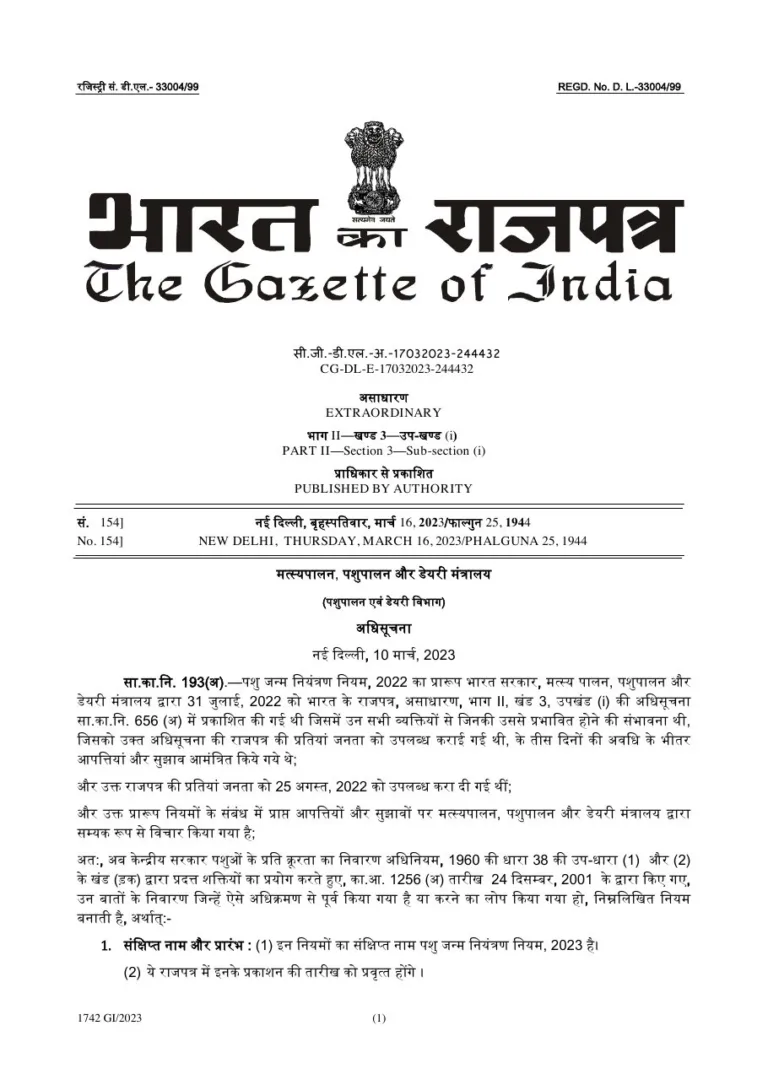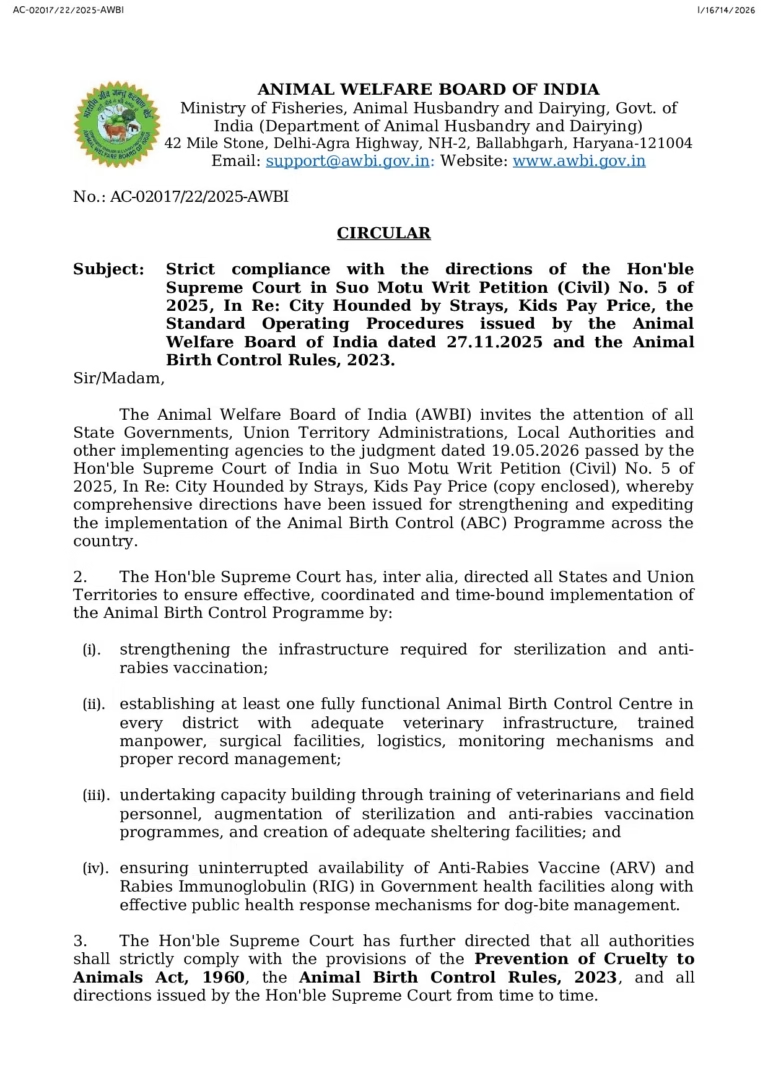
Your local body is responsible for street dogs: the municipal corporation in a city, the municipality in a town, and the district panchayat or district administration in rural areas. Under the Animal Birth Control Rules, 2023, it must sterilise and vaccinate street dogs and return them to the same area. To make a stray dog complaint to the municipal corporation, use its helpline, its grievance app or portal, or your ward office. This guide sets out what the rules say and the official channels in eight big cities.
Who is responsible for stray dogs?
- The local body. For street animals, the local authority is responsible for deworming, vaccination and sterilisation (Rule 8(2) of the Animal Birth Control Rules, 2023). It may hire an animal welfare organisation recognised by the Animal Welfare Board of India to do the work.
- What counts as a local body. The rules define it as a municipal committee or council, the district administration, a district panchayat or board, a cantonment board, or another authority that runs a local area by law (Rule 2(1)(m)). In a city, that is the municipal corporation.
- Which dogs. Street dogs, community Indian dogs and abandoned pedigree dogs that are homeless, living on the street or inside a gated campus (Rule 7(2)).
- Pet dogs. The owner is responsible for a pet dog’s deworming, vaccination and sterilisation (Rule 8(1)).
How the programme works, in short: what is Animal Birth Control (ABC) and how does it work.
What the local body must do
- Catch, sterilise, vaccinate and return. Dogs are caught humanely, sterilised and vaccinated at an ABC centre, and released at the same place they were caught (Rule 11(19)).
- Give notice first. Before dogs are caught in a locality, the local body or its partner puts up banners or public notices saying the dogs will be sterilised, vaccinated and returned (Rule 11(3)).
- Spare the young. Puppies under six months are not caught for sterilisation, and mothers are not caught until their litter is two months old (Rule 11(9)).
- Run a proper ABC centre. Kennels, vans, an operation theatre, CCTV and daily records (Rules 10 and 12).
- Set up a monitoring committee. A local ABC Monitoring Committee, chaired by the municipal commissioner or the local body’s executive officer, meets at least once a month (Rule 10(3), Schedule II).
- Take bite complaints. An Animal Complaint Cell at the ABC centre receives complaints about bites from street dogs suspected to have rabies (Rule 11(1)(b)). The local body may set up an animal helpline; each complaint is entered in a register (Rule 16).
- Run a helpline and feeding spaces. On the Supreme Court told every municipal body to create a helpline to report violations, and every ward to have dedicated feeding spaces (judgment of ). How feeding spots are agreed: feeding community dogs, and what to do if your RWA stops you.
What the local body may not do
- Catch dogs for other reasons. The rules allow catching for two purposes only: the ABC programme in an area, or specific complaints about bites from dogs suspected to have rabies (Rule 11(1)).
- Move healthy dogs elsewhere. Every dog is collared with a number so it goes back to the same area after sterilisation and vaccination (Rules 11(8) and 11(19)). The rules make no provision for removing or relocating healthy dogs.
- Catch cruelly. Nets or hands only; tongs and wires are banned (Rule 11(5)).
- Kill healthy dogs. Only incurably ill and mortally wounded dogs may be put to sleep, after diagnosis by a team named by the local ABC Monitoring Committee, by a qualified vet, in a humane way (Rule 15).
- Kill a dog suspected of rabies. It is kept in isolation and examined by a vet and an animal welfare organisation. If rabies is highly likely, it is isolated until it dies naturally; if not, it is treated and released after ten days (Rule 16(4) to (6)).
- Use harsher local rules. A local bye-law that is harsher on animals than these rules has no effect (Rule 22).
Court orders add to the rules. Since , stray dogs found inside schools, hospitals, sports complexes, bus stands and railway stations are taken to shelters after sterilisation and not released back there. On the Supreme Court said that where bites have become frequent, authorities may, after assessment by qualified vets and only as the law allows, take measures including euthanasia of rabid, incurably ill or dangerous dogs. Read the Supreme Court’s stray dog orders, explained.
How to make a stray dog complaint to the municipal corporation
Three routes work in most cities:
- The helpline or call centre. Ask for the veterinary or ABC department.
- The grievance app or portal. Choose the animal, dog or veterinary category if there is one.
- The ward office. Hand in a written complaint and ask for a receipt.
Whichever you use, note the complaint number. A complaint against stray dogs gets the same route as a complaint for them, such as an injured dog or dogs caught and not returned.
There is no single national stray dog helpline number. Each local body runs its own.
Official channels in eight cities (checked on the official websites on ):
- Mumbai: Brihanmumbai Municipal Corporation (BMC). Online grievance portal, “Management and Redressal of Grievance”, linked from the BMC website: marg.mcgm.gov.in.
- Delhi: Municipal Corporation of Delhi (MCD). The MCD 311 app, and “Lodge complaint MCD 311” on the MCD website, which also lists a Veterinary department.
- Bengaluru: Greater Bengaluru Authority (GBA). Since 2025 the city has five city corporations under the GBA: Central, North, East, South and West. Helpline 1533, and the Namma Bengaluru app (Sahaaya 2.0), from the GBA website, which also has a tool to find your new corporation and ward.
- Pune: Pune Municipal Corporation (PMC). The PMC CARE complaint system at complaint.pmc.gov.in, and the toll-free call centre 1800 1030 222.
- Kolkata: Kolkata Municipal Corporation (KMC). “Grievance KMC 2.0” at kmc.wb.gov.in, and grievance redressal on the KMC website.
- Hyderabad: Greater Hyderabad Municipal Corporation (GHMC). “Lodge Grievance” at igs.ghmc.gov.in, and the MyGHMC app, from the GHMC website. The GHMC website says GHMC has been split into three: GHMC, Cyberabad Municipal Corporation and Malkajgiri Municipal Corporation. Check which one covers your area.
- Chennai: Greater Chennai Corporation (GCC). Complaint number 1913, the Namma Chennai app and the online public grievance form, all on the GCC website. Its Veterinary Public Health department handles dogs.
- Ahmedabad: Amdavad Municipal Corporation (AMC). Citizen complaints at amccrs.com, and the call centre 155303, both from the AMC website.
Another city? Open your district in the Directory, or your local body’s own website.
Not a complaint but an emergency? For a person bitten, go to a hospital first: see dog bite in India: injection schedule, category, first aid. For a hurt dog, see found an injured animal: what to do and who to call for an animal emergency in India. If someone is harming a dog, see how to report animal cruelty.
What to note before you call
- The place: street, area, ward if you know it, and a landmark.
- The dogs: how many, their colour and size, and whether they have a V-shaped notch on the right ear, which marks a sterilised and vaccinated dog (Rule 11(16)).
- What happened: a bite, a sick or injured dog, dogs caught and not returned, or feeding trouble.
- When: dates and times, including when it started.
- Photos or videos, taken from a safe distance.
- Your name, address and phone. The rules ask the local body to record these with each complaint (Rule 16(1)).
- Earlier complaint numbers, if you have complained before.
If nothing happens
- Follow up with the complaint number, then write to the local body’s veterinary or ABC department.
- Write to the local ABC Monitoring Committee, through the municipal commissioner’s office. The local body must inquire into complaints that its ABC centre breaks the rules (Rule 10(4)).
- Write to your State Animal Welfare Board. The state’s ABC Implementation and Monitoring Committee inspects complaints about the programme and about breaches of the rules; the officer in charge of the State Board is its member secretary (Schedule II). Disputes over feeding spots go to the State Board on appeal (Rule 20(3)).
- Use the Animal Welfare Board of India’s grievance route: the online form on awbi.gov.in, or the grievance page, phone 0129-2555700, Monday to Friday, 9 am to 5:30 pm. The Board can send a team to inspect an ABC centre after a complaint (Rule 14). See Animal Welfare Board of India (AWBI): complaints, recognition and contact.
Who does what across the system: who regulates animal welfare in India.
Who can help on the ground
Rescue groups, ABC centres and vets can help with a sick dog, advise on sterilisation in your area and follow up with the local body. Find them by district in the Directory:
Mumbai · Delhi · Bengaluru · Pune · Kolkata · Hyderabad · Medchal-Malkajgiri · Ranga Reddy · Chennai · Ahmedabad
Not listed? Find your district. Living with dogs in your lane: caring for community dogs in your area and living alongside animals.
Questions and answers
This guide is general information, not legal advice.
 By Animal Writes