


Who is responsible for street dogs in your city, and how to reach them
Street dogs are your local body's job under the ABC Rules, 2023. What it must do, what it may not, and how to make a stray dog complaint in 8…

A research study developed a mathematical model to improve the management of free-roaming dog populations in southern India, focusing on sterilisation strategies for street dogs and community dogs. Free-roaming street dogs live closely with people, raising public health and safety concerns including disease transmission, bites, and traffic accidents. Many regions use surgical sterilisation to humanely manage these populations, but community managers often lack clear guidance on how to maximise limited resources. To address this, the authors simulated thousands of different sterilisation strategies to see how campaign length, frequency, and targeted sub-groups impacted population size and total costs. The findings indicate that short, repeated sterilisation campaigns are most effective for reducing population size and costs, especially when including dogs that receive some human care. Excluding dependent dogs that are cared for by humans severely constrains population reduction because their puppies continually replenish the street population. The study also emphasizes the importance of female sterilisation coverage while noting that sterilising male dogs can further enhance overall impact at little extra cost, assuming direct effects on pregnancy rates. Overall, cost-effective population reduction requires sustained commitment and coverage-driven strategies that balance welfare, population reduction, and operational needs. Costs and population impacts can be visualised on an interactive web application allowing practitioners and policymakers to explore sterilisation strategy outcomes. Practitioners and policymakers can use the interactive web application at field.shinyapps.io/DogPopSimApp to explore sterilisation strategy outcomes and design effective and financially sustainable dog management programmes that improve public health and animal welfare.
H.R. Fielding, P.R. Bessell, A.D. Gibson and others carried out the study, titled “Modelling sterilisation strategies to maximise population impact and cost-efficiency in free-roaming dog populations”. Read the study.
The study was published in bioRxiv on . See it in the journal.
A research study developed a mathematical model to improve the management of free-roaming dog populations in southern India, focusing on sterilisation strategies for street dogs and community dogs. Read the full study.
Summary written by Animal Writes. Read the original before relying on it.
Street dogs are your local body's job under the ABC Rules, 2023. What it must do, what it may not, and how to make a stray dog complaint in 8…

What the Animal Birth Control Rules, 2023 say about sterilising, vaccinating and returning community dogs.

A Research Square study of over 24,000 free-ranging dogs in four Indian shelters from 2018 to 2022 found physical trauma drove most admissions and non-live outcomes reached 40–60%. The researchers…
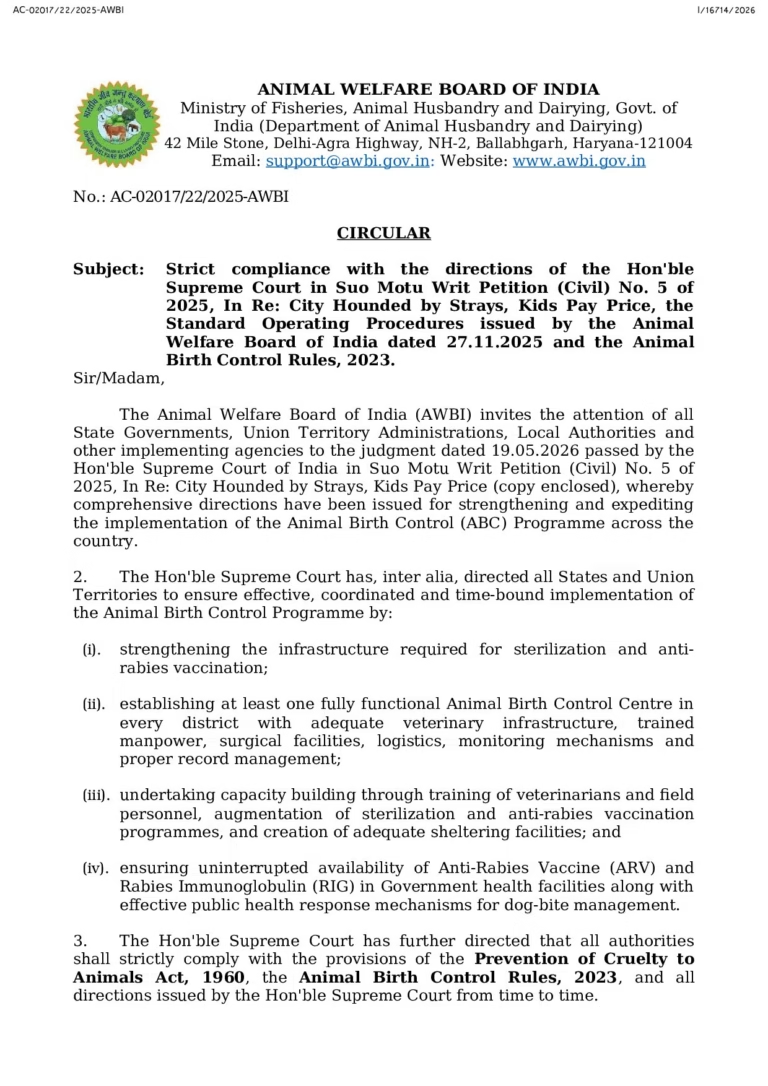
The Animal Welfare Board of India issued a circular requiring strict adherence to stray dog management regulations. The notice mandates compliance with Supreme Court of India orders from a 2025…
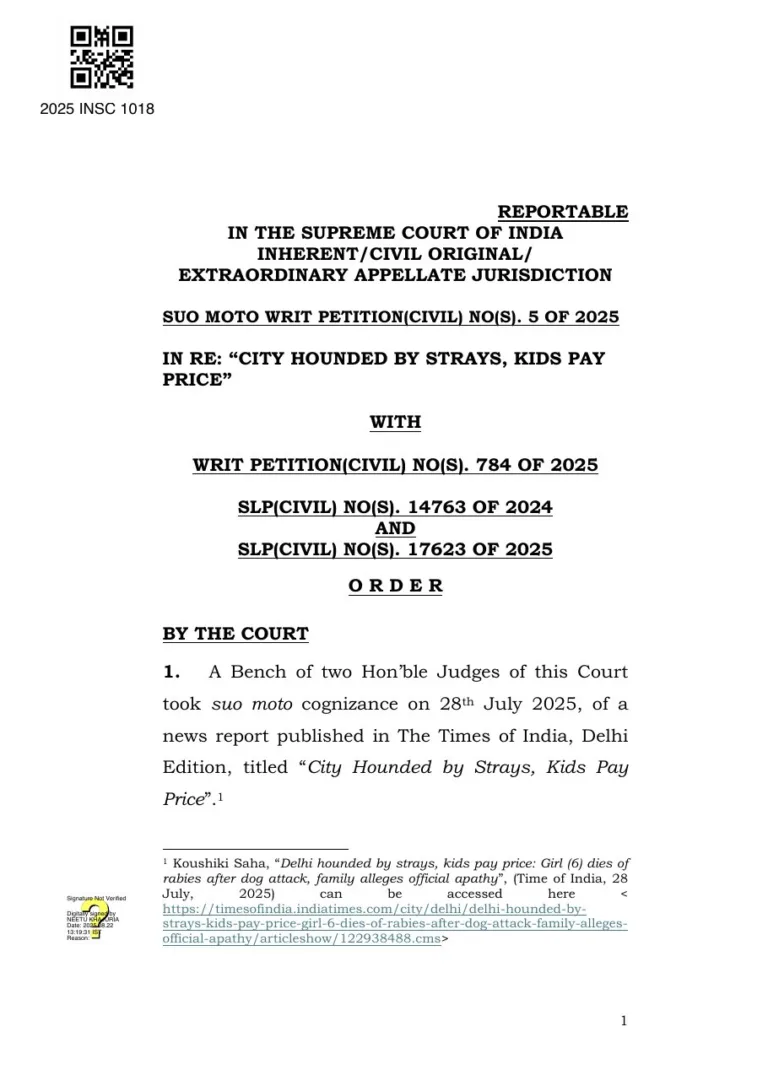
The Supreme Court of India issued a judgment regarding stray dogs on 22 Aug 2025, modifying its order of 11 Aug 2025. In Suo Motu Writ Petition (Civil) No. 5…

The Animal Welfare Board of India issued a circular directing that the revised Animal Birth Control (ABC) module dated 11 Aug 2025 be adopted as the Standard Operating Procedure (SOP)…
News, important developments and practical guides — no spam.