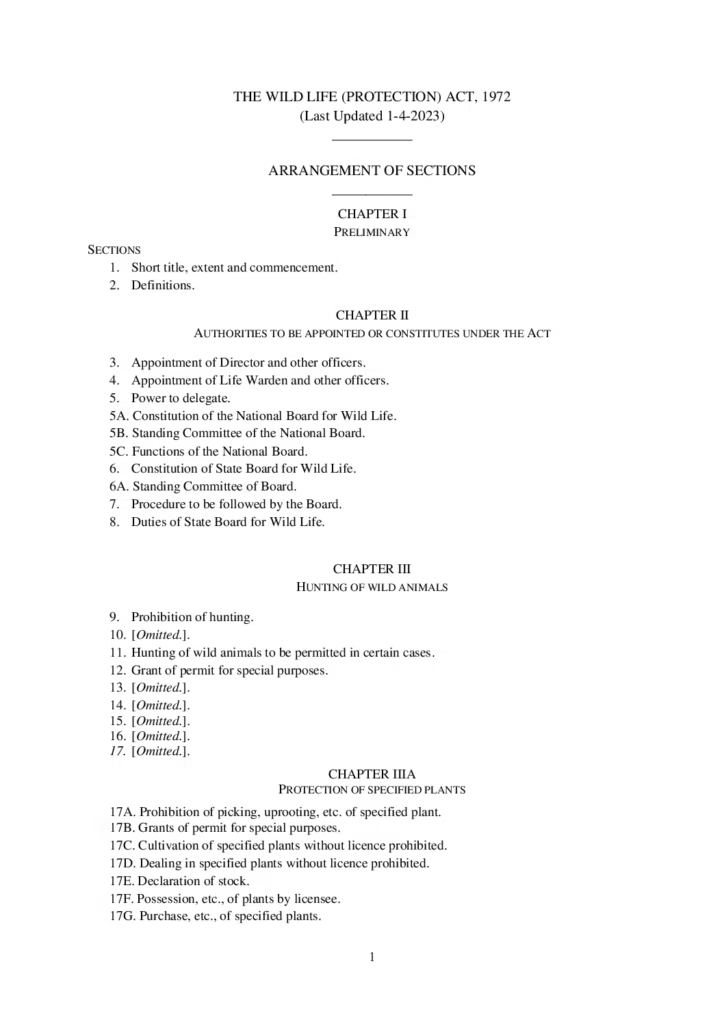
In India, exotic animals of species listed under CITES are in Schedule IV of the Wild Life (Protection) Act, 1972. Owners must register them on the PARIVESH 2.0 portal and report births, transfers and deaths. Breeding some of these species needs a licence from the state’s Chief Wildlife Warden.
Which exotic pets the law covers
Since the 2022 amendment, Chapter VB of the Wild Life (Protection) Act regulates the possession and trade of exotic species listed in Appendices I, II and III of CITES, through Schedule IV. Import of species not listed under CITES falls under the Foreign Trade (Development and Regulation) Act, 1992, and the Customs Act, 1962 applies at ports.
Registering an exotic pet on PARIVESH 2.0
- Section 49M makes declaration and registration of Schedule IV animals mandatory.
- The Living Animal Specimen (Reporting and Registration) Rules, 2023 require registration on PARIVESH 2.0, with numbers, sex and an identifier for each animal.
- Report a birth within 7 days and a transfer within 15 days. Deaths must also be reported.
- Owners must have each animal checked by a veterinarian registered with the Veterinary Council of India at least once every six months.
Breeding, buying and selling
- No one may breed Schedule IV species listed in CITES Appendix I without a licence from the Chief Wildlife Warden (sections 49N and 49-O; Breeders of Species Licence Rules, 2023).
- Section 49H bars trade in scheduled species except as Chapter VB allows. Scheduled specimens can be imported or exported only through 12 designated ports, including Chennai, Delhi, Mumbai, Kolkata and Kochi.
- Sellers may claim to hold valid permits, but buyers can rarely check this in real time.
Seizures and cruelty
- Forest officers, customs, police and the coast guard can seize illegally held exotic animals (section 50). Seized animals become government property (section 49Q).
- Cruelty to any animal, exotic or not, is an offence under the Prevention of Cruelty to Animals Act, 1960 and sections 291 and 325 of the Bharatiya Nyaya Sanhita, 2023. See how to report animal cruelty.
What the law does not cover yet
- There are no health standards for exotic pets after import, and no rule that vets report suspected zoonotic disease in them.
- Section 62A lets the Central Government regulate or ban invasive alien species, but it has never been used, and there is no official national list of invasive species.
- There is no national policy for owners to surrender an exotic animal they can no longer keep.
How big the trade is
The Ministry of Environment, Forest and Climate Change’s 2020 Voluntary Disclosure Scheme found over 40,000 people in 30 states and union territories keeping exotic pets. The trade was valued at about USD 42.6 million in 2024, and is projected to reach USD 75.8 million by 2030. Reptiles and birds dominate, such as green iguanas, royal ball pythons, African grey parrots and blue-and-gold macaws.
 By Animal Writes